Why Space-Based Solar Power Sounds Like Science Fiction

I wrote last week about plans to harvest solar power from space for places like data centers. If it sounds like science fiction, that might be because it was first imagined in a 1941 short story, "Reason," by Isaac Asimov. (see below)

It was formally proposed by engineer Peter Glasser in 1968, a space pioneer who introduced the idea of using satellites to beam solar energy from space down to Earth. Over the decades, what Glaser envisioned has been known by many names — space-based solar power (SBSP), solar-power satellites or satellite power system (SPS), as well as satellite solar-power system (SSPS). Glaser's contributions to space science and technology were not limited to the solar-power satellite concept. He also worked on NASA's Apollo moon missions and headed an experiment that flew aboard the space shuttle Columbia in 1986.

But solar power from space beamed to Earth has remained mostly theoretical due to cost and complexity.
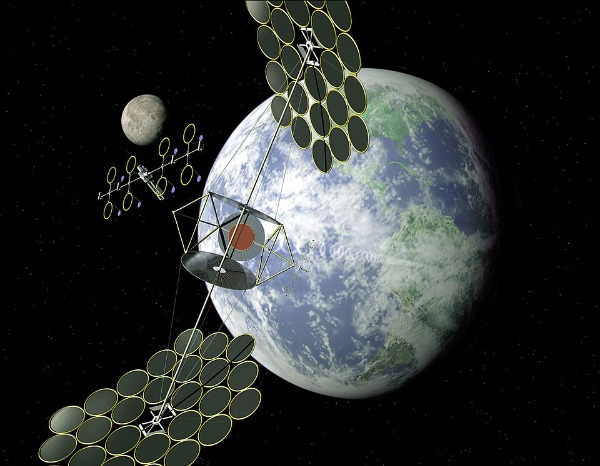
Solar Power From Space

solar power from space

NASA, Public domain, via Wikimedia Commons

Data centers need power. A lot of power. People don't want data centers in their neighborhoods. Where will it come from? From space?

Meta announced a deal with startup Overview Energy to purchase solar power collected by satellite and beamed back to Earth.

It is an experimental approach that could power data centers at night. Unlike traditional solar power, which relies on storing daylight, space-based solar power aims to deliver continuous energy.

Overview Energy plans to deploy satellites over 22,000 miles from Earth's equator, where they would collect and transmit infrared energy to solar panels. A test is scheduled for 2028, with a commercial rollout in 2030. Meta is seeking up to 1 gigawatt of power from the project, underscoring its energy needs for AI.

It sonds a bit wishful if you look at the numbers. In 2024, Meta's data centers consumed 18,000 times the electricity that this deal would deliver in a single hour. 

Space-based solar power (SBSP) involves harvesting solar energy in orbit and beaming it to Earth, providing 24/7 clean energy unaffected by weather, nighttime, or atmospheric filtering. There are challanges: high launch costs, complex orbital assembly of massive structures, and wireless energy transfer. 

The Enrollment Cliff

Education scholars talk about an “enrollment cliff,” and it stems from a simple demographic fact: after reaching a peak in 2007, the number of babies born annually in America generally declined for more than a decade.

During the next decade, there will be a steady drop in the number of this nation’s 18-year-olds, which will almost certainly lead to a spike in college closures and mergers throughout the country, not only at small private schools with less-than-élite academic reputations but also at large regional public schools.

“If my kid does want to attend college in 2035, how many schools will she actually have to choose from?” Jay Caspian Kang asks in this article on The New Yorker https://newyorkermag.visitlink.me/8QmCvL

The Canvas Hack

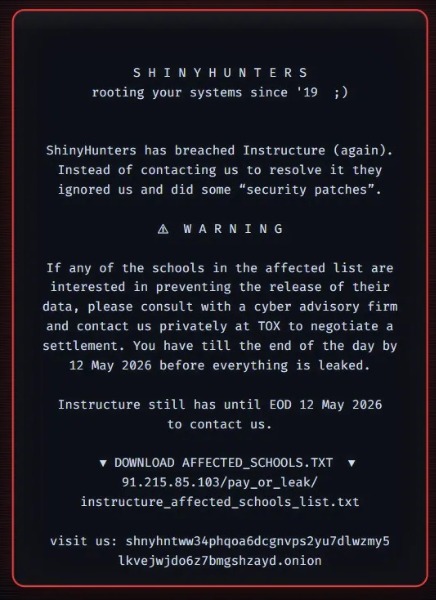
This month, colleges and universities across the country postponed final exams and due dates for assignments after Canvas, a learning management system used by 41 percent of North American higher ed institutions, temporarily went offline due to a hack. The University of Illinois at Urbana-Champaign postponed “all final exams and assignments, including papers, projects, etc., scheduled for Friday, Saturday, or Sunday,” provost John Coleman wrote to students and employees, and that, for “consistency and clarity,” the postponement affects all classes—even those that don't use Canvas.

Cybercrime group ShinyHunters identified itself as the hackers.

hack screen

Message that appeared to Canvas users

ShinyHunters first emerged in 2020 and claims to have successfully attacked 91 victims so far. The group is primarily after money, but has also been willing to cause reputational damage to their victims. In 2021, ShinyHunters announced they were selling data stolen from 73 million AT&T customers. ShinyHunters received global attention in 2025 after Google urged 2.5 billion users to tighten their security following a data breach via Salesforce, a customer management platform.

Unlike data breaches where hackers directly break into databases holding valuable information, ShinyHunters – and several other groups – have recently targeted major companies through voice-based social engineering, which is also known as “vishing,” for voice phishing. Social engineering is when a person is tricked or manipulated into providing information or performing actions that they wouldn’t normally do.