<?xml version="1.0" encoding="utf-8" ?>

<?xml-stylesheet type="text/xsl" href="/templates/2k11/atom.xsl" media="screen" ?>
<feed 
   xmlns="http://www.w3.org/2005/Atom"
   xmlns:rdf="http://www.w3.org/1999/02/22-rdf-syntax-ns#"
   xmlns:dc="http://purl.org/dc/elements/1.1/"
   xmlns:admin="http://webns.net/mvcb/"
   xmlns:slash="http://purl.org/rss/1.0/modules/slash/"
   xmlns:wfw="http://wellformedweb.org/CommentAPI/">
    
    <link href="https://serendipity35.net/index.php?/feeds/atom10.xml" rel="self" title="Serendipity35" type="application/atom+xml" />
    <link href="https://serendipity35.net/"                        rel="alternate"    title="Serendipity35" type="text/html" />
    <link href="https://serendipity35.net/rss.php?version=2.0"     rel="alternate"    title="Serendipity35" type="application/rss+xml" />
    <link rel="stylesheet" href="" type="text/css" />
    <title type="html">Serendipity35</title>
    <subtitle type="html">Where Technology and Education Meet - since 2006</subtitle>
    <icon>https://serendipity35.net/templates/2k11/img/s9y_banner_small.png</icon>
    <id>https://serendipity35.net/</id>
    <updated>2026-10-09T19:32:32Z</updated>
    <generator uri="http://www.s9y.org/" version="2.6.1">Serendipity 2.6.1 - http://www.s9y.org/</generator>
    <dc:language>en</dc:language>
    <admin:errorReportsTo rdf:resource="mailto:serendipity35blog@gmail.com" />

    <entry>
        <link href="https://serendipity35.net/index.php?/archives/3952-An-Estonian-Approach-to-Chatbots-in-Schools.html" rel="alternate" title="An Estonian Approach to Chatbots in Schools" />
        <author>
            <name>Kenneth Ronkowitz</name>
            <email>ronkowitz@gmail.com</email>        </author>
    
        <published>2026-10-09T15:35:00Z</published>
        <updated>2026-10-09T19:32:32Z</updated>
        <wfw:comment>https://serendipity35.net/wfwcomment.php?cid=3952</wfw:comment>
    
        <slash:comments>0</slash:comments>
        <wfw:commentRss>https://serendipity35.net/rss.php?version=atom1.0&amp;type=comments&amp;cid=3952</wfw:commentRss>
    
            <category scheme="https://serendipity35.net/index.php?/categories/60-AI,-ML,-Robots,-VR,-AR,-XR,-Metaverse" label="AI, ML, Robots, VR, AR, XR, Metaverse" term="AI, ML, Robots, VR, AR, XR, Metaverse" />
            <category scheme="https://serendipity35.net/index.php?/categories/56-K-12" label="K-12" term="K-12" />
            <category scheme="https://serendipity35.net/index.php?/categories/34-Teaching-Classroom-Practices" label="Teaching &amp; Classroom Practices" term="Teaching &amp; Classroom Practices" />
    
        <id>https://serendipity35.net/index.php?/archives/3952-guid.html</id>
        <title type="html">An Estonian Approach to Chatbots in Schools</title>
        <content type="html">
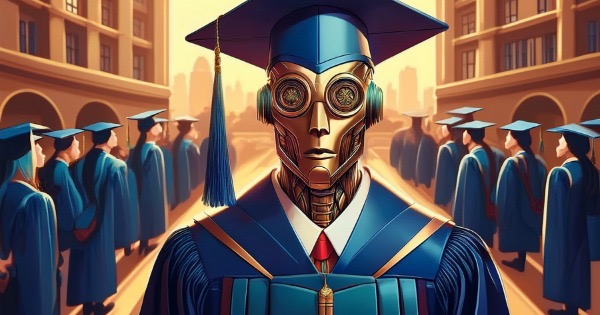
            <![CDATA[<p><!-- s9ymdb:2863 --><img alt="illustration" class="serendipity_image_center" height="436" loading="lazy" src="https://serendipity35.net/uploads/estonia_ai.jpg" width="800" />The use of AI in schools is a big topic right now in the U/S. and probably in most of the developed world.</p>

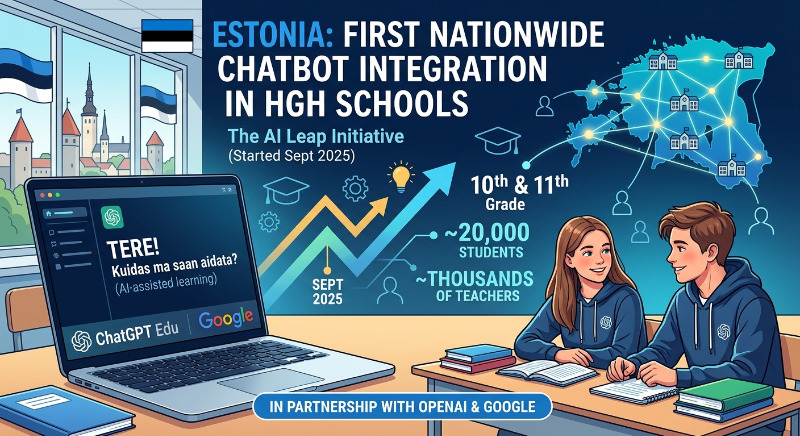
<p>Estonia is the first country to integrate a customized chatbot nationwide across its high school system, moving away from bans to embrace AI-assisted learning.</p>

<p>The AI Leap Initiative began in September 2025 for 10th and 11th-grade students, reaching nearly 20,000 students and thousands of teachers. They partnered with OpenAI to use ChatGPT Edu and Google.</p>

<p><strong>What is quite different about this version of a chatbot is that ChatGPT Edu uses the&#160;Socratic method. Instead of writing essays or giving direct answers, the customized AI acts like a coach. It guides students through problem-solving, reasoning, and critical thinking by asking questions rather than answering their questions.</strong></p>

<p>That is an approach that will seem strange and probably frustrating at first to a user who is used to the reverse model. If the student asks &quot;Why does the sky appear to be blue?&quot; the response may be &quot;What is your best guess at why it appears blue?&quot;</p>

<p>Teachers receive premium access to AI tools for lesson planning, administrative tasks, and reducing workload, alongside professional &quot;study circles&quot; for training.</p>

<p><a href="https://en.wikipedia.org/wiki/Estonia" target="_blank">Estonia</a> may seem to Westerners to be an odd choice for this experiment. I would not be surprised if an American had no idea where Estonia is located. Estonia,&#160;officially the Republic of Estonia, is a country in the Baltic region of Northern Europe bordered to the north by the Gulf of Finland across from Finland, to the west by the Baltic Sea across from Sweden, to the south by Latvia, and to the east by Russia.&#160;OpenAI noted that&#160;Estonia is already among the top 15 countries globally for ChatGPT usage. They have one active ChatGPT account for every four citizens, and aggregated usage data shows Estonians use ChatGPT primarily for tutoring and teaching, computer programming, and writing.</p>

<p><a href="https://openai.com/index/estonia-schools-and-chatgpt/" target="_blank">https://openai.com/index/estonia-schools-and-chatgpt/</a>&#160;</p>

 ]]>
        </content>
        
    </entry>
    <entry>
        <link href="https://serendipity35.net/index.php?/archives/3949-Vintage-Artificial-Intelligence.html" rel="alternate" title="Vintage Artificial Intelligence" />
        <author>
            <name>Kenneth Ronkowitz</name>
            <email>ronkowitz@gmail.com</email>        </author>
    
        <published>2026-09-10T11:12:00Z</published>
        <updated>2026-09-10T02:52:31Z</updated>
        <wfw:comment>https://serendipity35.net/wfwcomment.php?cid=3949</wfw:comment>
    
        <slash:comments>0</slash:comments>
        <wfw:commentRss>https://serendipity35.net/rss.php?version=atom1.0&amp;type=comments&amp;cid=3949</wfw:commentRss>
    
            <category scheme="https://serendipity35.net/index.php?/categories/60-AI,-ML,-Robots,-VR,-AR,-XR,-Metaverse" label="AI, ML, Robots, VR, AR, XR, Metaverse" term="AI, ML, Robots, VR, AR, XR, Metaverse" />
            <category scheme="https://serendipity35.net/index.php?/categories/69-Web-History" label="Web History" term="Web History" />
    
        <id>https://serendipity35.net/index.php?/archives/3949-guid.html</id>
        <title type="html">Vintage Artificial Intelligence</title>
        <content type="html">
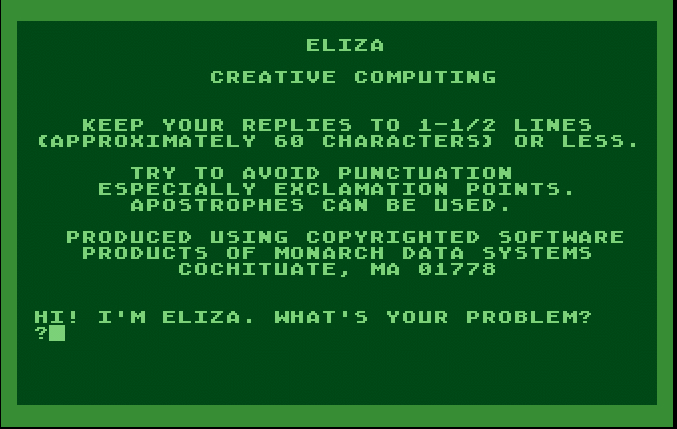
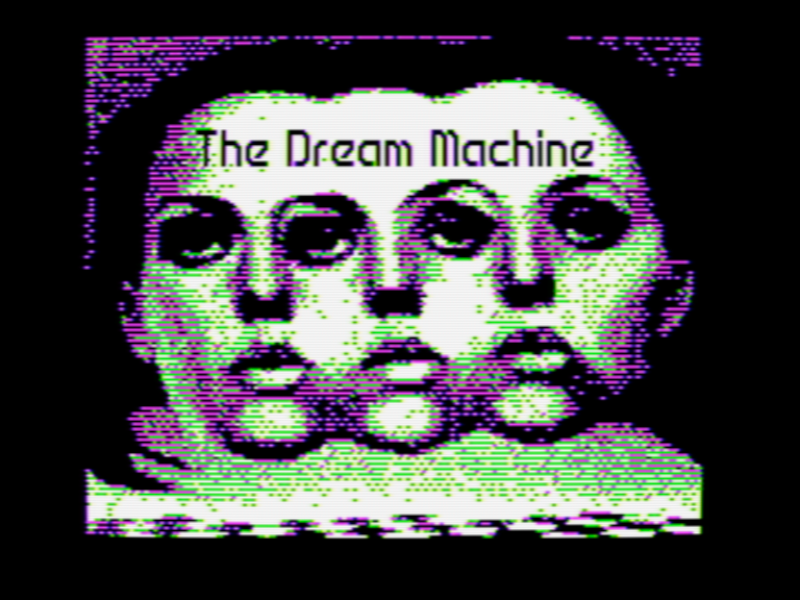
            <![CDATA[<p><!-- s9ymdb:2860 --><img alt="Eliza" class="serendipity_image_center" height="429" loading="lazy" src="https://serendipity35.net/uploads/eliza.gif" width="677" />From approximately 1970 through the 1990s, a number of emulated software packages, spanning many sources and with many motivations, portrayed microcomputers and game consoles as thinking machines. These programs attempted to predict the experience of creating autonomous or semi-autonomous virtual entities, or of playing games with the illusion of a contemplative and improvisational opponent.&#160;</p>

<p style="text-align: center;"><!-- s9ymdb:2861 --><img alt="Dream Machine" class="serendipity_image_center" height="600" loading="lazy" src="https://serendipity35.net/uploads/dream.png" width="800" /></p>

<p>Now, those programs are curated for public enjoyment in one place. Introducing the <a href="https://archive.org/details/vintageai" target="_blank"><strong>Vintage Artificial Intelligence Collection</strong></a>, now available on archive.org. This&#160;curated collection of early computer software claims some aspect of artificial intelligence as a primary feature, allowing early interactions of humans and machines before things got a little strange. The collection includes a variety of programs intended as therapists, conversation partners, and opponents.</p>

<p style="text-align: center;"><!-- s9ymdb:2862 --><img alt="Little Computer People" class="serendipity_image_center" height="576" loading="lazy" src="https://serendipity35.net/uploads/little_people.png" width="768" /></p>

<p>&#160;</p>

 ]]>
        </content>
        
    </entry>
    <entry>
        <link href="https://serendipity35.net/index.php?/archives/3950-Teaching-Humans,-Learning-with-Machines.html" rel="alternate" title="Teaching Humans, Learning with Machines" />
        <author>
            <name>Tim Kellers</name>
            <email>trkellers@cloudlocal.us</email>        </author>
    
        <published>2026-09-05T23:18:00Z</published>
        <updated>2026-09-06T19:34:20Z</updated>
        <wfw:comment>https://serendipity35.net/wfwcomment.php?cid=3950</wfw:comment>
    
        <slash:comments>0</slash:comments>
        <wfw:commentRss>https://serendipity35.net/rss.php?version=atom1.0&amp;type=comments&amp;cid=3950</wfw:commentRss>
    
    
        <id>https://serendipity35.net/index.php?/archives/3950-guid.html</id>
        <title type="html">Teaching Humans, Learning with Machines</title>
        <content type="html">
            <![CDATA[<p><!-- s9ymdb:2859 --><img alt="" class="serendipity_image_center" height="436" loading="lazy" src="https://serendipity35.net/uploads/AIkindercademy.png" width="800" /></p>

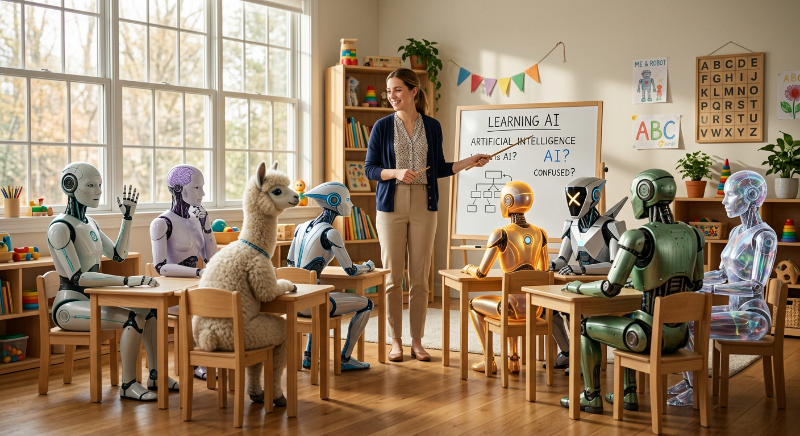
<p>This was a new challenge for me. A classroom full of adults all with that look -- the drift&#160;between eager to learn and anxious about learning.&#160;&#160;I was the instructor&#160;in&#160;&#160;a reskilling program at the Carnegie Library in New Jersey.&#160;My job was to teach&#160;web development to displaced workers who had spent&#160;years in jobs in factories and retail. Their faces told that displacement part well. They were all <a href="https://www.flyingmag.com/why-does-the-pilot-in-command-sit-on-the-left-side-of-the-cockpit/">sitting in the left seat</a> on the runway and they had no idea&#160;how to fly an airplane.</p>

<p>I&#39;ve taught across the learning&#160;spectrum &mdash; computer newbies who couldn&#39;t find the power button, college sophomores writing their first iOS app, certification candidates cramming Open Source Unix for a credential, and mid-career professionals trying to recompile&#160;their job opportunities&#160;through code. Each group arrives on their stairway landing with&#160;different fears and different metaphors they use to make sense of the landscape. The fundamental transaction is always the same: a person&#160;on&#160;the edge of their competence, looking st a gap, and asking someone they barely know to help them build a bridge</p>

<p>When you teach a true beginner, you can&#39;t start with abstractions. You have to find the concrete thing they already understand and build from there. In a <a href="https://blog.udemy.com/basic-computer-skills/">Basic Computer Literacy</a> course, I explained differences in database servers&#160;by comparing them&#160;&#160;to a <a href="https://visitnj.org/article/diner-capital-of-the-world">Diner</a>&#160;during the breakfast rush &mdash; requests come in, the cook (server) handles them in turn, things get backed up (queues), the grill needs more people cooking (scaling and replication). The metaphor clicked because the Diner experience was shared among them all.&#160; I wasn&#39;t just teaching them something new; I was using language and examples they all knew fluently.</p>

<p>AI does something remarkably similar. When I ask it to explain a <a href="https://kubernetes.io/">Kubernetes</a> deployment strategy, it doesn&#39;t launch into a whitepaper. It asks what I already know, or it guesses based on context, and it finds the analogical handhold. It&#39;s not always right &mdash; sometimes the metaphor is strained, sometimes it assumes I know <a href="https://www.docker.com/">Docker</a> when I barely know what a container is. But the impulse is identical: meet the learner where they are, and move forward.</p>

<p>The intermediate learner is a different creature entirely. They&#39;ve built something that works, which gives them confidence, but they haven&#39;t yet built something that fails spectacularly. Teaching them means letting them wander into the goo&#160;of complexity and then helping them get unstuck so they can find their way out. I taught iOS development to students who could get a button to change color but couldn&#39;t yet reason about memory management or delegation patterns. The temptation is to hand them the answer, but the actual teaching happens in the struggle &mdash;in the moment where they stare at <a href="https://www.google.com/goto?url=CAESjwEB6zswFUGfuMnFg1w-0M2XV2MFy0S-bJR0aFqvNsscZKpfUt5n6PdzN1pLu0bBOSs4PBmh5P52wpONsEHcla4LOhvYmQuPr59AXHgboKrrlzp5m-XkffCrMMO2OxTsnK841eoQ0Gf-PL-yuYzUyZ1nktGYhEzOGXk-skCt2OtJeT7iTtlkv56oj-C8BdIkEw">structs and classes</a>&#160;and realize the <a href="https://developer.apple.com/xcode/">Xcode </a>tool they used to create them&#160;now demands the language be understood.</p>

<p>AI struggles here. Not because it lacks the knowledge, but because it lacks the patience for productive frustration. When a student is circling a concept, a human teacher reads the confusion and lets the silence hang. AI, optimized for helpfulness, tends to fill that silence with the answer. It&#39;s like having a tutor who can&#39;t stand to watch you squirm and teaches very little. Squirming is often where the learning happens.</p>

<p>The advanced learner is easier in some ways and harder in others. By the time someone is studying for an Open Source Unix certification or architecting a web application, they know what they don&#39;t know. The teaching relationship becomes collaborative. You&#39;re not handing down knowledge from Olympus; you&#39;re comparing notes with someone who has a different vantage on the same mountain.</p>

<p><br />
Here AI shines. It has read more documentation than any human could memorize. It can rattle off the difference between <a href="https://FreeBSD.org">FreeBSD</a>&#39;s jail system and Linux containers, cite the relevant man pages, and suggest edge cases I hadn&#39;t considered. It&#39;s like having a colleague who never sleeps and has perfect recall of every technical manual ever written. There is an incompleteness to it.&#160;&#160;The advanced learner isn&#39;t just looking for information; they&#39;re looking for judgment. They want to know whether a particular architectural choice is wise, not just possible. They want someone to say, &quot;We tried that in 2019 and it was a disaster.&quot; AI has no 2019. It has no disaster. It has only patterns and probabilities, a knowledge structure without synthesis --a long way away from <a href="https://en.wikipedia.org/wiki/Wisdom">wisdom</a>.</p>

<p>The reskilling audience taught me the most about what learning actually requires. These were people who had been told by the economy that their skills no longer mattered, and now they were being asked to bet on themselves one more time. The emotional stakes were enormous. A syntax error wasn&#39;t just a syntax error; it was confirmation of their fear that they weren&#39;t smart enough for this. A working script wasn&#39;t just a working script; it was evidence that they could still grow, still adapt, still matter.</p>

<p>No AI can see that fear. No AI can offer the look across a desk that says, &quot;I know this is hard, and I know you&#39;re scared, and I&#39;m not going anywhere until you get it.&quot; The human teacher is not just a source of information; they&#39;re a witness. They bear testimony to the student&#39;s struggle and eventual triumph. They create a context in which failure is survivable because someone else is watching and believes it will be okay.</p>

<p>And yet&#160;AI is always there. It doesn&#39;t get tired, doesn&#39;t judge, doesn&#39;t carry the baggage of its own bad day into the interaction. A student who is embarrassed to ask a &quot;stupid question&quot; in front of a human will happily ask AI the same thing at 2 AM, phrasing it awkwardly, getting a patient answer, and trying again. There is no shame in the machine. For learners who have been corralled by shame before &mdash; by classrooms where they fell behind, by colleagues who made them feel small &mdash; AI is a sanctuary.</p>

<p>I&#39;ve come to think of it this way: human teaching is like running with a partner. They set the pace, they encourage you when you flag, they notice when you&#39;re about to redline and suggest a slower target. They share the struggle. AI teaching is like a treadmill. It&#39;s always ready, always consistent, never judgmental. It will run with you for as long as you want, at whatever pace you choose. But if you trip, it won&#39;t catch you. If you need to stop and cry, it won&#39;t hand you a towel and tell you about the time it felt the same way.</p>

<p>The best learning probably happens in the space between &mdash; where AI handles the informational heavy lifting, the patient repetition, the infinite availability, and the human handles the witness, the belief, the judgment born of scars. I taught a zillion students over the years, and I remember the ones who were struggling more vividly than the ones who breezed through. I remember the looks of &quot;Aha&quot; in the <a href="https://blog.udemy.com/basic-computer-skills/">BCL</a>&#160;class when the diner metaphor clicked. I remember the woman in the reskilling program who cried when her first PHP form actually submitted a POST. AI will never remember any of it. But it will be there for the next one, and the next, and the next, patient and tireless and empty.</p>

<p>Perhaps that&#39;s the real comparison. We teach because we were taught. The chain of human knowledge is also a chain of human care. AI is a tool &mdash; an extraordinary one, a transformative one &mdash; but it&#39;s not a link in that chain. It&#39;s a convenience&#160;that returns&#160;what we ask of it, without ever understanding why the question mattered.</p>

 ]]>
        </content>
        
    </entry>
    <entry>
        <link href="https://serendipity35.net/index.php?/archives/3948-Claiming-The-Digital-Homestead.html" rel="alternate" title="Claiming The Digital Homestead" />
        <author>
            <name>Tim Kellers</name>
            <email>trkellers@cloudlocal.us</email>        </author>
    
        <published>2026-08-25T20:31:00Z</published>
        <updated>2026-08-27T03:29:43Z</updated>
        <wfw:comment>https://serendipity35.net/wfwcomment.php?cid=3948</wfw:comment>
    
        <slash:comments>0</slash:comments>
        <wfw:commentRss>https://serendipity35.net/rss.php?version=atom1.0&amp;type=comments&amp;cid=3948</wfw:commentRss>
    
    
        <id>https://serendipity35.net/index.php?/archives/3948-guid.html</id>
        <title type="html">Claiming The Digital Homestead</title>
        <content type="html">
            <![CDATA[<p style="text-align: justify;"><!-- s9ymdb:2857 --><img alt="" class="serendipity_image_center" height="445" loading="lazy" src="https://serendipity35.net/uploads/system-online.png" width="800" />&#160;</p>

<p>&#160;Building something yourself that the world insists you should buy as a subscription feels like victory --it feels <em>good!</em>.<br />
<br />
Open any tech newsletter today, the narrative is entirely about corporate gatekeeping. You are told that to participate in the &quot;AI revolution,&quot; you need to pony up twenty or thirty dollars a month per seat for a sterile, browser-based chatbot that lives on a corporate server farm, tracks your data, and updates its personality out from under you. If you decide to go the developer route and tinker with your own integrations, you are warned of the dreaded &quot;sticker shock&quot;&mdash;accidental loops that can run up a hundred-dollar-a-day bill before you&rsquo;ve even finished your morning coffee.<br />
<br />
It all feels a bit like those early days of&#160;<a href="https://en.wikipedia.org/wiki/Dial-up_Internet_access">dial-up</a>&#160;network computing.</p>

<p>Back then, if you wanted to access the wider digital world, you had to navigate a gauntlet of compounding costs. First, you&rsquo;d pay connect-time charges to dial into a supporting public data carrier like&#160;<a href="https://en.wikipedia.org/wiki/Telenet">Sprint</a>&#160;(which operated the early Telenet network). Then, you might subscribe to an access utility just to route to non-local numbers without being billed by the minute by the phone company. And finally, once your modem successfully squealed its way through the pipe, you paid a premium, by-the-minute surcharge just to access the content and mainframe forums of&#160;<a href="https://en.wikipedia.org/wiki/CompuServe">CompuServe</a>&#160;or&#160;<a href="https://en.wikipedia.org/wiki/The_Source_(online_service)">The Source</a>. If you lingered too long reading a thread, the meter was always running, and your monthly bill would arrive looking like a car payment. About the only survivor of that primordial era still ticking today is&#160;<a href="https://www.aol.com/">AOL</a>.&#160; And, yes, even though AOL dialup was retired almost a year ago,&#160;<a href="https://www.aol.com/products/browsers/desktop-gold">AOL Desktop Gold </a>is still available and runs under Windows right up through Windows 11.<br />
<br />
Today&rsquo;s AI ecosystem has resurrected that exact same billing anxiety. If you set up a custom AI integration, every single turn of the conversation is billed by the character. If you ask your system to monitor a database, check your server health, or help you debug a script, the &quot;connect-time&quot; starts ticking, and the API charges pile up rapidly.<br />
But by setting up a virtual private&#160;&#160;flat-rate&#160;<a href="https://en.wikipedia.org/wiki/FreeBSD">FreeBSD</a>&#160;&quot;pipe&quot; for twenty dollars a month&mdash;the&#160;modern equivalent of finding a local, non-toll access number&mdash;and pairing it with an open-source gateway like&#160;<a href="https://openclaw.ai/">OpenClaw</a>, we&rsquo;ve effectively bypassed those premium mainframe surcharges.<br />
It is the&#160;modern equivalent of an offline reader for complex computing functions. Utilizing a technique called&#160;<a href="https://docs.anthropic.com/en/docs/build-with-claude/prompt-caching">prompt caching</a>&mdash;which essentially allows the AI to remember the context of our ongoing conversation for fractions of a penny rather than re-reading the whole book every time we speak&mdash;&#160;the billing meter has been tamed and the data keeps flowing.<br />
<br />
Instead of watching the meter spin&#160;up dollar signs&#160;all day, our actual daily API token costs have plummeted to mere pennies.<br />
When you look at the actual ledger, the results are almost comical. For about&#160;<b>one dollar a day</b>&mdash;the combined cost of our flat-rate FreeBSD server hosting, our open-source gateway platform, and our optimized, highly active token access&mdash;we&#160;have a completely private, personal dedicated&#160;AI presence available all the time.<br />
&#160;</p>

<p>The geeky technical details of how the caching works and how the gateway maps those commands and what they all do, are subjects for a later post.&#160;For now, standing in my digital workshop, I&rsquo;m just enjoying the view. It is proof that with a little consistency, a respect for pacing, and a refusal to run the race at a corporate sprint, you can still stake-out a remarkably advanced corner of the future on a lunch-money budget.</p>

 ]]>
        </content>
        
    </entry>
    <entry>
        <link href="https://serendipity35.net/index.php?/archives/3947-A-Good-Space-Hack-for-the-Voyagers.html" rel="alternate" title="A Good Space Hack for the Voyagers" />
        <author>
            <name>Kenneth Ronkowitz</name>
            <email>ronkowitz@gmail.com</email>        </author>
    
        <published>2026-08-17T18:35:00Z</published>
        <updated>2026-08-10T22:30:43Z</updated>
        <wfw:comment>https://serendipity35.net/wfwcomment.php?cid=3947</wfw:comment>
    
        <slash:comments>0</slash:comments>
        <wfw:commentRss>https://serendipity35.net/rss.php?version=atom1.0&amp;type=comments&amp;cid=3947</wfw:commentRss>
    
            <category scheme="https://serendipity35.net/index.php?/categories/52-Research" label="Research" term="Research" />
            <category scheme="https://serendipity35.net/index.php?/categories/32-Tech" label="Tech" term="Tech" />
            <category scheme="https://serendipity35.net/index.php?/categories/68-Tech-History" label="Tech History" term="Tech History" />
    
        <id>https://serendipity35.net/index.php?/archives/3947-guid.html</id>
        <title type="html">A Good Space Hack for the Voyagers</title>
        <content type="html">
            <![CDATA[<figure class="serendipity_imageComment_center" style="width: 800px">
<div class="serendipity_imageComment_img"><!-- s9ymdb:2858 --><img alt="voyager" class="serendipity_image_center" height="486" loading="lazy" src="https://serendipity35.net/uploads/voyager.jpg" width="800" /></div>

<figcaption class="serendipity_imageComment_txt">
<p style="text-align: center;">Concept art of NASA&rsquo;s Voyager 1 spacecraft in interstellar space. Credit: NASA/JPL-Caltech</p>
</figcaption>
</figure>

<p>&quot;Hack&quot; sometimes has a bad reputation. But there are some good hacks.In technology and computing, it has two meanings:<br />
1. Unauthorized Access (verb): To gain illegal or unauthorized access to data, a computer system, or a network (e.g., &quot;My account got hacked&quot;).<br />
2. Clever Code Solution (noun/verb): An elegant, clever, or quick fix in programming that solves a tricky problem.</p>

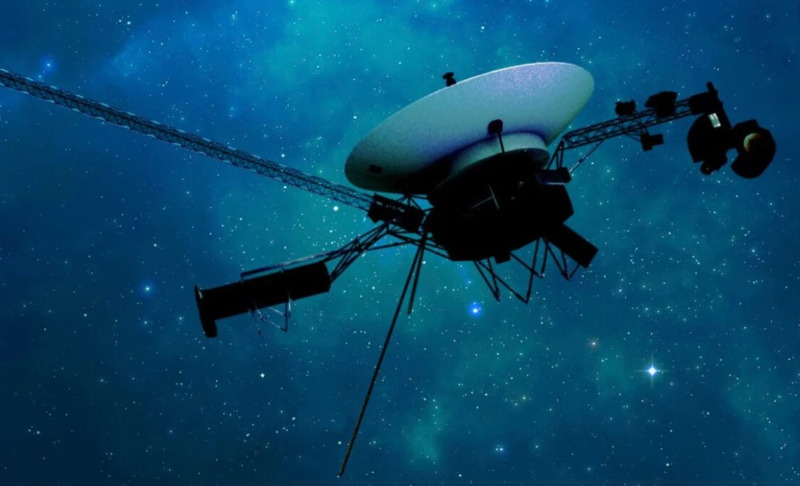
<p>We turn to space. NASA&#39;s Voyager 1 is still moving through interstellar space at over 35,000 miles per hour (56,000 kilometers per hour). It is 15 billion miles (about 24 billion km) away from Earth.</p>

<p>NASA&#39;s Jet Propulsion Lab wants it to keep going for just a bit longer.</p>

<p>There are two&#160;Voyagers, both launched in the late summer of 1977. They are wonderful relics. These older electronics give off waste heat - which is usually a bad thing - but it keeps practically every instrument onboard warm.</p>

<p>It will run out of power. That was expected to happen quite a while ago, but it keeps on going. So now, JPL is doing a critical power-saving hack on sister probe, Voyager 2. They&rsquo;re toggling on and off Voyager 2&rsquo;s key components across a coordinated sequence. It conserves energy but still keeps things from freezing.</p>

<p>Why Voyager 2? It was closer to Earth and had more power to test this hack. It worked and now they want to the hack on the farther-out Voyager 1.</p>

<p>What is their power supply?&#160;They both have modest nuclear power plants. These thermoelectric generators convert heat produced by the natural radioactive decay of plutonium-238 into electricity. That plutonium isotope is decaying toward its 88-year half-life, so less heat is being emitted.</p>

<p>The probes launched with 10 instruments apiece. Some have been powered down because they served their purpose when they were moving through the planets in our solar system.</p>

<p>I hope Voyager 1 makes it to November and hits a historic milestone. It passes one light-day&rsquo;s distance from Earth. That is a fraction of one light-year, but it is also 173 times the distance between Earth and the Sun.</p>

<p>If it passes that point and stays online, it will take messages over 24 hours to reach it. Its 50th anniversary will be on September 5, 2027.</p>

 ]]>
        </content>
        
    </entry>
    <entry>
        <link href="https://serendipity35.net/index.php?/archives/3943-Killed-by-Google.html" rel="alternate" title="Killed by Google" />
        <author>
            <name>Kenneth Ronkowitz</name>
            <email>ronkowitz@gmail.com</email>        </author>
    
        <published>2026-08-10T10:49:00Z</published>
        <updated>2026-08-06T00:38:33Z</updated>
        <wfw:comment>https://serendipity35.net/wfwcomment.php?cid=3943</wfw:comment>
    
        <slash:comments>0</slash:comments>
        <wfw:commentRss>https://serendipity35.net/rss.php?version=atom1.0&amp;type=comments&amp;cid=3943</wfw:commentRss>
    
            <category scheme="https://serendipity35.net/index.php?/categories/69-Web-History" label="Web History" term="Web History" />
    
        <id>https://serendipity35.net/index.php?/archives/3943-guid.html</id>
        <title type="html">Killed by Google</title>
        <content type="html">
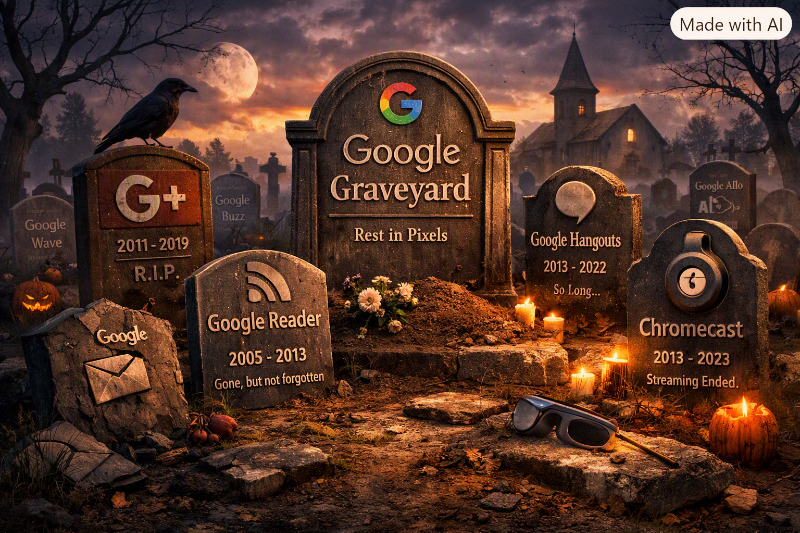
            <![CDATA[<p><a href="https://killedbygoogle.com/" target="_blank"><strong>Killed by Google </strong></a>is a website that compiles lists of all the apps, services, and hardware Google has abandoned over the years. There are a lot.&#160;</p>

<p>For example, in apps&#160;<a href="https://www.theverge.com/tech/962479/get-google-earth-pro-while-you-still-can" target="_blank">Google Earth Pro</a> was a desktop app that gave users access to Google Earth with more advanced features. It will be about 26 years old when it ends its life.</p>

<p>The&#160;<a href="https://en.wikipedia.org/wiki/Tenor_(website)" target="_blank">Tenor API</a>&#160;service was killed about 1 month ago. It was used to search for and share GIFs from Tenor&#39;s database on other websites (notably Discord). It was about 11 years old.</p>

<p>In the hardware category, I have a&#160;<a href="https://www.theverge.com/2024/8/6/24214471/google-chromecast-line-discontinued" target="_blank">Chromecast </a>in a drawer even though it was killed almost 2 years ago. Chromecast was a line of digital media players that allowed users to play online content on a television. It was about 11 years old.</p>

<p style="text-align: center;"><!-- s9ymdb:2855 --><img alt="graves" class="serendipity_image_center" height="533" loading="lazy" src="https://serendipity35.net/uploads/google_graves.png" width="800" /></p>

 ]]>
        </content>
        
    </entry>
    <entry>
        <link href="https://serendipity35.net/index.php?/archives/3942-AI-Democracy,-OpenClaw-for-us-all.html" rel="alternate" title="AI Democracy, OpenClaw for us all" />
        <author>
            <name>Tim Kellers</name>
            <email>trkellers@cloudlocal.us</email>        </author>
    
        <published>2026-08-04T16:38:00Z</published>
        <updated>2026-08-04T16:41:53Z</updated>
        <wfw:comment>https://serendipity35.net/wfwcomment.php?cid=3942</wfw:comment>
    
        <slash:comments>1</slash:comments>
        <wfw:commentRss>https://serendipity35.net/rss.php?version=atom1.0&amp;type=comments&amp;cid=3942</wfw:commentRss>
    
    
        <id>https://serendipity35.net/index.php?/archives/3942-guid.html</id>
        <title type="html">AI Democracy, OpenClaw for us all</title>
        <content type="html">
            <![CDATA[<p style="margin-bottom:11px"><!-- s9ymdb:2852 --><img alt="unlocking the box" class="serendipity_image_center" loading="lazy" src="https://serendipity35.net/uploads/ai-democracy-key.png" style="width: 600px;" /></p>

<p style="margin-bottom:11px"><span style="font-size:12pt"><span style="line-height:115%"><span style="font-family:Aptos,sans-serif"><span style="font-family:&quot;Arial&quot;,sans-serif">There is a particular kind of quiet that settles over a terminal window at 8 a.m. on a Tuesday when you are the only person on earth who can see what is happening on the other end of it. No support ticket. No status page to refresh. Just you, a config file, and a decision about who, exactly, gets to talk to the thing you just built.</span></span></span></span></p>

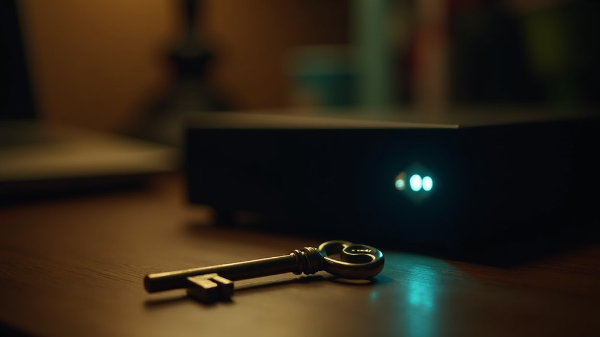
<p style="margin-bottom:11px"><span style="font-size:12pt"><span style="line-height:115%"><span style="font-family:Aptos,sans-serif"><span style="font-family:&quot;Arial&quot;,sans-serif">I spent part of this morning doing precisely that &mdash; flipping a setting called `gateway.bind` from `loopback` to `lan`, watching a self-signed certificate mint itself into existence, and approving a device pairing request from my own phone as if I were a bouncer checking my own ID at a door I installed myself. It is, by any reasonable measure, boring infrastructure work. And it is also, I have come to think, one small answer to a question my Serendipity35 co-conspirator Ken raised in this space a few months back in &#39;<a href="https://serendipity35.net/index.php?/archives/3921-Your-AI-Is-Not-Free.html">Your AI Is Not Free&#39;</a>&quot;?: if free AI makes you the product, what does *running your own* make you?</span></span></span></span></p>

<p style="margin-bottom:11px"><span style="font-size:12pt"><span style="line-height:115%"><span style="font-family:Aptos,sans-serif"><span style="font-family:&quot;Arial&quot;,sans-serif">Most people&#39;s relationship with artificial intelligence today is one of tenancy, not ownership. You open ChatGPT, or Claude.ai, or the Gemini app, and you are a guest in someone else&#39;s skyscraper &mdash; a very nice skyscraper, with excellent amenities, but a skyscraper nonetheless, and the lease terms are the landlord&#39;s to write and rewrite. Your prompts, your corrections, your half-finished thoughts typed in at midnight: all of it lives on servers you will never see, governed by a privacy policy you almost certainly didn&#39;t read past the second paragraph. &quot;Free&quot; is a business model, not a gift, and Ken said as much in this space not long ago.</span></span></span></span></p>

<p style="margin-bottom:11px"><span style="font-size:12pt"><span style="line-height:115%"><span style="font-family:Aptos,sans-serif"><span style="font-family:&quot;Arial&quot;,sans-serif"><a href="https://openclaw.ai/">OpenClaw &mdash; the open-source project</a> I&#39;ve been quietly building&#160;on both my Mac Studio and my <a href="https://freebsd.org"><strong>nexttroll.com</strong> </a>domain this week &mdash; offers a different architecture, and it is worth walking through precisely because the architecture is the point. You run the gateway process yourself. You supply your own API keys to whichever model you choose to pay for &mdash; <a href="https://claude.ai">Anthropic</a>, <a href="https://aistudio.google.com/">Google</a>, whoever earns your dollar this quarter &mdash; and you pay for compute the way you pay for electricity, metered and legible, rather than a flat-rate subscription that obscures what any single conversation actually cost. Your logs, your memory files, your configuration: all of it sits as plain files on a disk I can `ls` myself, not as an abstraction behind someone else&#39;s login screen.</span></span></span></span></p>

<p style="margin-bottom:11px"><span style="font-size:12pt"><span style="line-height:115%"><span style="font-family:Aptos,sans-serif"><span style="font-family:&quot;Arial&quot;,sans-serif">There is a second piece of this worth dwelling on, because it is the part that actually excited me: **Skills**. In a cloud AI product, the vendor decides what the assistant is allowed to do, and you are notified of new capabilities the way you are notified of app updates &mdash; after the fact, and without a vote. In OpenClaw, a Skill is a modular, inspectable procedure &mdash; a little packaged competence &mdash; that you add, edit, or write outright. You are not a user of a product anymore. You are closer to being the systems administrator of a very small, very personal machine &mdash; which, if you have read this blog for any length of time, you will recognize as exactly the seat I have always preferred.</span></span></span></span></p>

<p style="margin-bottom:11px"><span style="font-size:12pt"><span style="line-height:115%"><span style="font-family:Aptos,sans-serif"><span style="font-family:&quot;Arial&quot;,sans-serif">None of the actual sovereignty here lives in anything glamorous. It lives in bind modes, auth tokens, TLS certificates, device pairing approvals &mdash; the unglamorous plumbing that determines who can reach your AI and what it is permitted to see. I spent a genuinely irritating stretch of this morning discovering that a browser will flatly refuse to hand over &quot;device identity&quot; to anything served over plain HTTP from a LAN address, because modern WebCrypto requires what&#39;s called a secure context, and no amount of arguing with a curl command changes that. The fix &mdash; self-signed TLS, a certificate warning to click through, a pairing request to approve &mdash; was ten minutes of real friction. It was also, I noticed afterward, the first time all week I understood *exactly* why a piece of software was refusing me, rather than just accepting that it had.</span></span></span></span></p>

<p style="margin-bottom:11px"><span style="font-size:12pt"><span style="line-height:115%"><span style="font-family:Aptos,sans-serif"><span style="font-family:&quot;Arial&quot;,sans-serif">That, I think, is the actual shape of &quot;AI democracy&quot; here &mdash; and I want to be precise about what I mean by it, because it is not a claim that everyone will run an identical assistant, or that we&#39;re all about to become network engineers. It means the tools required to configure and own a working AI assistant no longer live exclusively behind a computer science degree or a corporate badge. The barrier moved. It used to be technical. Now it is largely a matter of persistence &mdash; a willingness to sit through the boring, occasionally maddening reps of learning why a thing is broken before you can fix it. I have written before about training a 5K at seventy: nobody hands you the fitness. You do the unglamorous mileage, and it accrues.</span></span></span></span></p>

<p style="margin-bottom:11px"><span style="font-size:12pt"><span style="line-height:115%"><span style="font-family:Aptos,sans-serif"><span style="font-family:&quot;Arial&quot;,sans-serif">I&#39;ll concede the honest caveats, because a post that skips them isn&#39;t worth the pixels. This is real effort, not a weekend hobby &mdash; there were dead ends this week, a Rust compiler grinding through hundreds of crates in the background the whole time as a reminder that not everything gets easier. And this is not full independence, whatever the word &quot;sovereignty&quot; might suggest. I am still, at the end of the day, paying Anthropic for the actual intelligence doing the thinking; I have relocated the boundary of control, not abolished my dependence on a large company entirely. Self-hosting an AI gateway doesn&#39;t make you off the grid. It makes you legible to yourself, which is a smaller and more honest promise.</span></span></span></span></p>

<p style="margin-bottom:11px"><span style="font-size:12pt"><span style="line-height:115%"><span style="font-family:Aptos,sans-serif"><span style="font-family:&quot;Arial&quot;,sans-serif">There&#39;s an irony sitting underneath all of this that I don&#39;t want to paper over: the assistant that helped me research and draft this very post &mdash; reading through nineteen pages of my own back catalog to get the voice roughly right, checking a Gemini API key against my own config, watching a build compile in the background &mdash; is the same private, locally-configured AI this post is about. I did not write every sentence above; I directed the machine that wrote most of them, on hardware I own, with API keys I hold, in a conversation that will live in a file on my own disk when we&#39;re done. Consider this piece Exhibit A, not just an argument.</span></span></span></span></p>

<p style="margin-bottom:11px"><span style="font-size:12pt"><span style="line-height:115%"><span style="font-family:Aptos,sans-serif"><span style="font-family:&quot;Arial&quot;,sans-serif">So &mdash; not an answer, but a question worth carrying to your own terminal, wherever it happens to sit: if you actually knew, with certainty, where your last conversation with an AI physically lived &mdash; whose disk, whose jurisdiction, whose future data breach &mdash; would you have said anything differently to it?</span></span></span></span></p>

 ]]>
        </content>
        
    </entry>
    <entry>
        <link href="https://serendipity35.net/index.php?/archives/3933-AI-Overviews-and-Data-Center-Power.html" rel="alternate" title="AI Overviews and Data Center Power" />
        <author>
            <name>Kenneth Ronkowitz</name>
            <email>ronkowitz@gmail.com</email>        </author>
    
        <published>2026-07-31T09:55:00Z</published>
        <updated>2026-07-31T15:19:48Z</updated>
        <wfw:comment>https://serendipity35.net/wfwcomment.php?cid=3933</wfw:comment>
    
        <slash:comments>0</slash:comments>
        <wfw:commentRss>https://serendipity35.net/rss.php?version=atom1.0&amp;type=comments&amp;cid=3933</wfw:commentRss>
    
            <category scheme="https://serendipity35.net/index.php?/categories/60-AI,-ML,-Robots,-VR,-AR,-XR,-Metaverse" label="AI, ML, Robots, VR, AR, XR, Metaverse" term="AI, ML, Robots, VR, AR, XR, Metaverse" />
            <category scheme="https://serendipity35.net/index.php?/categories/23-ISSUES" label="ISSUES" term="ISSUES" />
    
        <id>https://serendipity35.net/index.php?/archives/3933-guid.html</id>
        <title type="html">AI Overviews and Data Center Power</title>
        <content type="html">
            <![CDATA[<figure class="serendipity_imageComment_center" style="width: 600px">
<div class="serendipity_imageComment_img"><!-- s9ymdb:2842 --><img alt="data center" class="serendipity_image_center" height="399" loading="lazy" src="https://serendipity35.net/uploads/amz_data.jpg" width="600" /></div>

<figcaption class="serendipity_imageComment_txt">
<p style="text-align: center;">A U.S. Amazon data center<br />
<a href="https://commons.wikimedia.org/w/index.php?curid=135864697" target="_blank">Image: Tedder - CC BY-SA 4.0</a></p>
</figcaption>
</figure>

<p>&#160;</p>

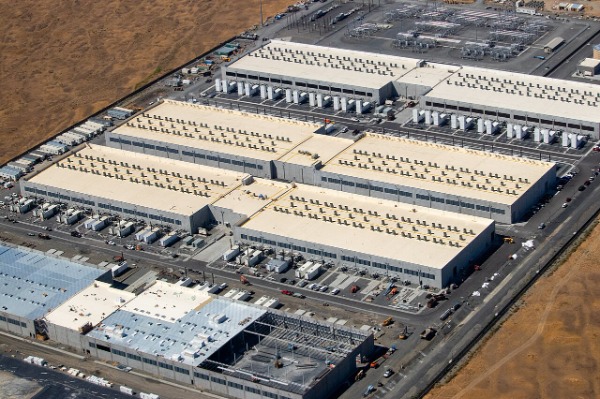
<p><a href="https://substack.com/@pogueman" target="_blank">David Pogue on Substack</a> writes that &quot;When you do a Google search these days, you generally see an AI Overview panel above the search results. It&rsquo;s intended to summarize the answers to your query, so you don&rsquo;t have to click any links.&#160;The first problem: By Google&rsquo;s own calculations, the AI Overviews are incorrect 28% of the time.&#160;The bigger problem: AI is an environmental disaster. It&rsquo;s already a monstrous energy hog, and its appetite is doubling every six months.&quot;</p>

<p>&#160;He gives some data about this data center power situation:</p>

<ul>
	<li>4,200 data centers that AI companies have built and 1,500 more are going up as you read this</li>
	<li>By 2030, AI will consume 945 terawatt-hours of electricity. That is enough to power every household in California, Texas, Florida, New York, Ohio, and Pennsylvania combined. Almost incomprehensible.</li>
	<li>60% of that power will come from polluting power sources.</li>
	<li>Don&rsquo;t care about the environment? How about your power bill? AI&rsquo;s power needs have driven up electricity costs as much as 15% in the last year, with another 8.5% hike coming by the end of 2026.</li>
	<li>Add in more rolling blackouts during heat waves this summer.</li>
</ul>

<p>But it&rsquo;s not just Google, because almost every big company is eager to add AI to their products.</p>

<p>Pogue&#39;s note of hope is that a few people, like&#160;Sheila Morovati, are trying to make AI optional.&#160;Morovati is the founder and president of a nonprofit called <a href="http://HabitsofWaste.org" target="_blank">HabitsofWaste.org</a>.&#160;Her movement is&#160;called&#160;<a href="https://habitsofwaste.org/featured-campaigns/opt-in-ai/">Opt-In AI</a>&#160;with a goal of no AI at all unless someone asks for it. The default setting should be the most sustainable and least annoying option.</p>

<p>More at&#160;<a href="https://substack.com/home/post/p-200908579" target="_blank">Rise Up, People! Make AI Optional! - David Pogue</a></p>

 ]]>
        </content>
        
    </entry>
    <entry>
        <link href="https://serendipity35.net/index.php?/archives/3939-A-Podium-and-the-IT-Revolution.html" rel="alternate" title="A Podium and the IT Revolution" />
        <author>
            <name>Tim Kellers</name>
            <email>trkellers@cloudlocal.us</email>        </author>
    
        <published>2026-07-28T00:17:00Z</published>
        <updated>2026-09-02T13:47:12Z</updated>
        <wfw:comment>https://serendipity35.net/wfwcomment.php?cid=3939</wfw:comment>
    
        <slash:comments>0</slash:comments>
        <wfw:commentRss>https://serendipity35.net/rss.php?version=atom1.0&amp;type=comments&amp;cid=3939</wfw:commentRss>
    
    
        <id>https://serendipity35.net/index.php?/archives/3939-guid.html</id>
        <title type="html">A Podium and the IT Revolution</title>
        <content type="html">
            <![CDATA[<p style="text-align: center;"><!-- s9ymdb:2847 --><!-- s9ymdb:2847 --><img alt="" class="serendipity_image_left" height="293" loading="lazy" src="https://serendipity35.net/uploads/Santabot.serendipityThumb.png" width="400" /></p>

<p style="text-align: center;">&#160;</p>

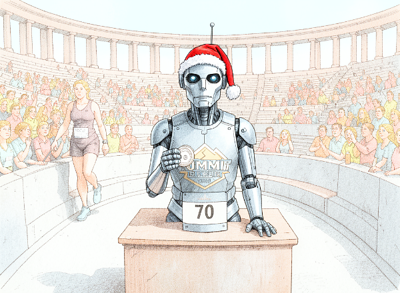
<p>There is a distinct, sharp flavor to the air at 7:00 AM on a race morning. It is an eclectic mix of adrenaline, Icy-Hot, and the squeak of synthetic race bibs. But last weekend, standing on a wooden riser an hour after the start with two other finishers, the air felt a bit different. For the first time in fourteen years, I was back on the podium.</p>

<p>At age 70, standing there with an age-group award hanging around my neck, my mind did what it always did after decades spent in operating systems, development and design--it looked to the Dev process, and the Prod result. Fourteen years is an eternity in the technology sector. Fourteen years ago, the cloud was a novel corporate transition, deep learning was mostly academic, and the smartphone was just beginning to corral us all into interpersonal isolation.</p>

<p>I spent my career trying to ride the rocket of overwhelming technical information or, at least, watch where it was headed. But as I caught my breath and looked down at my silver medal, I realized that the grueling, quiet process of training for a 5K road race at seventy is perhaps the most perfect metaphor we have for coping with the relentless acceleration of modern information technology.</p>

<p>When you are 25, you can run a 5K on raw talent and a bad diet. I did. You can sprint, redline your heart rate, and force your way to the finish line through sheer kinetic stubbornness.</p>

<p>When you train at 70, sprinting is a fast track to a torn quad or a zillion other structural failures. You learn to respect your physiological redline even if it is maddeningly slow. You focus heavily on pacing, aerobic threshold, and efficient energy expenditure. You make the effort and run as hard as you ever might have run --you just don&#39;t go as fast anymore.</p>

<p>The tech world operates in a state of permanent sprint. Every week brings a large language model, a new framework, or an interface that threatens to render yesterday&#39;s skills obsolete. If you try to sprint after every single shiny object in the tech ecosystem, you will suffer cognitive burnout. Coping with tech acceleration requires us to embrace our aerobic base of lifelong learning--choosing a sustainable pacing strategy over frantic, reactive sprinting.</p>

<p>In my IT days, I spent time on optimization--making sure old code could run on new infrastructure, new code could run in a legacy environment, or that software upgrades didn&#39;t brick any of those resources.</p>

<p>Training a 70-year-old body is an intense exercise in refactoring. The joints are stiffer, muscle mass naturally declines, and recovery loops take twice as long. The default settings of your youth are, at best, just an annoying memory. You have to actively invest in mobility work, strength training, and strict recovery cycles just to maintain baseline performance. Your stopwatch now records time more like a calendar.</p>

<p>Navigating modern IT infrastructure requires us to consciously refactor our mind. The user interfaces of today don&#39;t look like the command lines or desktop environments we grew up configuring. To be functional, we have to deliberately loosen our rigid mental models, accept that our personal processing speed has changed, and invest in assistive technology in our environments.</p>

<p>Fourteen years ago, my running report card was inside a cheap Casio runners watch. Today, my wrist is strapped to a device that tracks VO2 max, heart rate variability, stride power, and sleep architecture. In training mode, this unrelenting device excoriates me out loud for being &quot;Too Slow,&quot; &quot;Too Fast&quot; (really rarely that one), or &quot;Pace within target range&quot; as I lumber along.</p>

<p>The data is only useful if you know how to filter the signal from the noise. If I noticed every minor dip in my training metrics, I would never lace up my shoes. I had to learn which data mattered for long-term durability and which data were just distractions.</p>

<p>The acceleration of technology has created an information flood. We are bombarded with notifications, algorithmic opinions, and an endless stream of digital noise. Coping doesn&#39;t mean disconnecting entirely; it means developing strict personal filtering protocols. It means knowing which metrics actually improve your digital life and ignoring the rest.</p>

<p>Standing on that podium, I looked at the younger runners finishing behind (the few) and ahead (the many) of me. In running, as in technology, it is easy to look at the speed of the world around you and feel a creeping sense of obsolescence. <span style="line-height:18.4px"><span style="color:#000000"><span style="font-style:normal"><span style="font-weight:normal"><span style="white-space:normal"><span style="text-decoration-line:none"><span style="text-decoration-thickness:auto"><span style="text-decoration-style:solid">Endurance sports, though, reveal a beautiful truth: the race is both intensely communal and deeply solitary. You are running with the pack, and share their energy--but you are ultimately executing your own race plan.</span></span></span></span></span></span></span></span></p>

<p>The tech revolution can leave older generations feeling like technology spectators as younger digital natives zoom all around them. But my return to the podium reminded me that experience compounds. Fourteen years of absence didn&#39;t mean I lost the ability to compete; it meant I had fourteen years of accrued wisdom regarding pacing, emotional resilience, and consistency fighting against old-age decline.</p>

<p>We don&#39;t need to write the algorithms to benefit from them, nor do we need to build the networks to find meaningful space within them. We just have to stay on the course, run our race, and remember that if you stay consistent long enough, the finish line will provide its own rewards.</p>

<hr style="font-style:normal; font-weight:400; text-align:start; white-space:normal; text-decoration-line:none; text-decoration-thickness:auto; text-decoration-style:solid" />
 ]]>
        </content>
        
    </entry>
    <entry>
        <link href="https://serendipity35.net/index.php?/archives/3938-Apple-II-almost-Infinitum.html" rel="alternate" title="Apple II almost Infinitum" />
        <author>
            <name>Tim Kellers</name>
            <email>trkellers@cloudlocal.us</email>        </author>
    
        <published>2026-07-18T15:31:00Z</published>
        <updated>2026-07-18T15:40:59Z</updated>
        <wfw:comment>https://serendipity35.net/wfwcomment.php?cid=3938</wfw:comment>
    
        <slash:comments>0</slash:comments>
        <wfw:commentRss>https://serendipity35.net/rss.php?version=atom1.0&amp;type=comments&amp;cid=3938</wfw:commentRss>
    
    
        <id>https://serendipity35.net/index.php?/archives/3938-guid.html</id>
        <title type="html">Apple II almost Infinitum</title>
        <content type="html">
            <![CDATA[<figure class="serendipity_imageComment_center" style="width: 600px">
<div class="serendipity_imageComment_img"><!-- s9ymdb:2846 --><img alt="Apple II Infinitum" class="serendipity_image_center" height="327" loading="lazy" src="https://serendipity35.net/uploads/_A2in.png" title="Apple II Infinitum" width="600" /></div>
</figure>

<p>Fifty years ago, a pair of college dropouts named Steve Jobs and Steve Wozniak fundamentally shifted human history. The significance of&#160;1976&#160;to Apple Computers cannot be overstated: it was the literal ground zero of the personal computing revolution. On April 1, 1976, Apple Computer was formed, and by July, the duo unveiled the&#160;Apple I&#160;at the Homebrew Computer Club. Selling for a diabolical $666.66, the&#160;Apple I&#160;was just a bare motherboard. But it funded Wozniak&rsquo;s next masterpiece: the 1977&#160;Apple II, a fully realized, consumer-friendly machine featuring color graphics, expansion slots, and an integrated keyboard.</p>

<p>Fast forward to&#160;July 14&ndash;19, 2026. While modern Apple users await iterative upgrades to sleek aluminum slabs, retrocomputing diehards are descending upon the&#160;University of Illinois Springfield&#160;for&#160;<a href="https://kansasfest.org" target="_blank">KansasFest (KFest) 2026</a>. Now in its 38th consecutive year, KFest remains the ultimate pilgrimage for hackers, programmers, and enthusiasts keeping the 8-bit dream alive.</p>

<p>This year&rsquo;s convention is a historic milestone, marking the&#160;40th anniversary of the Apple IIGS, the 16-bit pinnacle of the Apple II line released in 1986.The event features a packed schedule of legendary guests, collaborative hackathons, and hardware swap meets:In-Person Keynote: Apple Employee #12,&#160;<a href="https://en.wikipedia.org/wiki/Daniel_Kottke">Dan Kottke</a>, is headlining the event live to share stories from the foundational garage days of Apple. Dan Hillman, the engineer who co-led the development of the Mega II chip (which squeezed an entire Apple IIe onto a single piece of silicon), is making a rare virtual appearance.</p>

<p>The Global Gathering: For those unable to travel to Illinois, KFest 2026 is also hosting an official&#160;virtual-only weekend event on July 31 &ndash; August 1, 2026.<br />
<br />
<strong><span style="font-size:18px;">A History Born of Crisis...</span></strong></p>

<p>KFest wasn&#39;t always an independent nonprofit. It originally launched in&#160;1989&#160;as an official Apple II developers&#39; conference organized by&#160;Resource Central, a publisher of Apple II magazines. When Apple decided to completely discontinue the Apple IIGS in late 1992 and the final Apple IIe in November 1993, corporate support evaporated. The market plummeted, and&#160;Resource Central&#160;faced a severe financial crisis by 1995. This (Low-Def) video was thought to be of the last ever KFest.</p>

<div>
<div><iframe allow="accelerometer; autoplay; clipboard-write; encrypted-media; gyroscope; picture-in-picture; web-share" allowfullscreen="" frameborder="0" height="285" referrerpolicy="strict-origin-when-cross-origin" src="https://www.youtube.com/embed/LgBcy5sLZAk" title="KansasFest 1995" width="552"></iframe></div>

<p>&#160;</p>

<p>Refusing to let the platform vanish, a passionate community volunteer committee took over the reins in 1995. They managed the logistics, housing, and speaker schedules out of pure love for the architecture. To ensure its long-term survival, the convention officially incorporated as a non-profit corporation,&#160;KansasFest Inc., in 2015.</p>

<p>Over the decades, KFest has relied&#160;on grassroots support and regular community sponsors. Entities like&#160;A2Central.com&#160;(the premier hub for Apple II news), retro-hardware vendors, and individual community patrons provide the financial backing needed to rent university dorms, fund speaker travel, and subsidize student admissions.</p>

<p>So how does a computer line discontinued for more than three decades still maintain a dominant grip on the retrocomputing landscape? The answer lies in&#160;Steve Wozniak&rsquo;s masterful, open-architecture design.</p>

<p>Unlike Steve Jobs&rsquo; vision of a locked-down, appliance-like Macintosh, Wozniak insisted the Apple II feature&#160;eight internal expansion slots. This design made the computer virtually un-killable. If a component failed or became obsolete, a user could simply pull off the lid and swap it out. That structural choice created an open invitation for hackers to experiment&mdash;an invitation that remains open today.</p>

<p>Rather than sitting under glass in museums, the Apple II continues to see breathtaking new hardware and software development:</p>

<p><strong><span style="font-size:18px;">Building Modern Hardware</span></strong></p>

<p>Hobbyists don&rsquo;t use fragile 5.25-inch floppy disks anymore. Today&#39;s Apple II computers are augmented with modern tech:</p>

<p><em>Solid-State Storage:</em> CompactFlash and SD card adapters mimic traditional floppy drives, allowing users to load thousands of software titles instantly.</p>

<p><em>FPGA and Chip Replacements:</em> Developers are successfully using field-programmable gate arrays (FPGAs) to build drop-in replacements for obsolete Apple custom chips, like the MMU and IOU, ensuring the physical machines can run for another 50 years.</p>

<p><em>Network Capabilities:</em> Peripheral cards give these 1 MHz machines the ability to connect to modern Wi-Fi networks and surf the text-based web via TCP/IP protocols.</p>

<p><strong>&#160;<span style="font-size:18px;">Elegant Software Engineering</span></strong></p>

<p>The software scene is equally vibrant, proving that 48KB of RAM is more than enough space for modern genius.</p>

<p>Bringing <a href="https://swift.org">Swift </a>to the 8-Bit Era: In a stunning feat of modern software engineering, developer Yeo Kheng Meng successfully built a development environment that ports&#160;Apple&rsquo;s modern Swift programming language&#160;to run on the 6502 processor of the original Apple II and IIe.<br />
Demanding Demos and Games: New operating system tweaks, graphical demos, and complex homebrew indie games are released annually at KFest, squeezing visual tricks out of the machine that engineers in the 1970s thought were mathematically impossible.</p>

<p>Steve Wozniak built the Apple II to be a tool for ordinary people to learn, modify, and master technology. By keeping the hood open, he created a community that refuses to let the machine die.</p>

<p>As KFest 2026 kicks into high gear, it is clear that the legacy started in a California garage in 1976 isn&#39;t just history&mdash;it&#39;s a living, breathing, coding reality.</p>

<p>&#160;</p>
</div>

 ]]>
        </content>
        
    </entry>
    <entry>
        <link href="https://serendipity35.net/index.php?/archives/3928-Are-You-in-a-Deepfake-Image-or-Video.html" rel="alternate" title="Are You in a Deepfake Image or Video?" />
        <author>
            <name>Kenneth Ronkowitz</name>
            <email>ronkowitz@gmail.com</email>        </author>
    
        <published>2026-07-08T04:36:00Z</published>
        <updated>2026-07-08T20:26:32Z</updated>
        <wfw:comment>https://serendipity35.net/wfwcomment.php?cid=3928</wfw:comment>
    
        <slash:comments>0</slash:comments>
        <wfw:commentRss>https://serendipity35.net/rss.php?version=atom1.0&amp;type=comments&amp;cid=3928</wfw:commentRss>
    
            <category scheme="https://serendipity35.net/index.php?/categories/65-Ethics-Morality-in-Tech" label="Ethics &amp; Morality in Tech" term="Ethics &amp; Morality in Tech" />
            <category scheme="https://serendipity35.net/index.php?/categories/61-Privacy,-Security" label="Privacy, Security" term="Privacy, Security" />
    
        <id>https://serendipity35.net/index.php?/archives/3928-guid.html</id>
        <title type="html">Are You in a Deepfake Image or Video?</title>
        <content type="html">
            <![CDATA[<p>&#160;</p>

<p>YouTube is giving all creators 18 and over access to a tool that can detect whether their likeness has been copied and used in AI videos uploaded to the website. Known as deepfakes,&#160;these are AI-generated videos, images, or audio that make it look like someone said or did something they never actually said or did.</p>

<p>Team YouTube made an announcement, explaining that their &quot;goal is to provide [users] with more peace of mind by giving [them] easy access to request the removal of unauthorized content.&quot; While their likeness detection tool is technically available only to creators, spokesperson Jack Malon said that anyone can use it.&#160;</p>

<p>The tool allows you to:<br />
Identify where your likeness shows up.<br />
Understand if others are using your face in videos made with AI.&#160;<br />
Safeguard your identity by requesting removal of unauthorized content that uses your likeness directly in YouTube Studio.<br />
Keep your viewers from being misled about you.</p>

<p>An AI model is trained on lots of real photos, videos, or audio of a person &mdash; the more data, the better the fake. Then, using techniques like generative adversarial networks (GANs) or diffusion models, the AI swaps faces, clones voices, or creates entirely new footage that mimics the person&rsquo;s appearance, expressions, and voice.&#160;Modern tools can match lighting, lip movements, blinking, and even subtle mannerisms to make the result really convincing.</p>

<p>In a face swap, it replaces one person&rsquo;s face with another face. A lip sync can change what someone appears to be saying<br />
Voice cloning can copy someone&rsquo;s voice from audio samples. What is known as full-body puppetry can control gestures and expressions and make a still photo &ldquo;talk&rdquo; and move.</p>

<p>Most articles about this technology are negative and point out risks, such as misinformation, non-consensual fake content, scams, identity fraud, and reputation damage.</p>

<p>If you do see positive uses, they&#160;will often not be called &quot;deepfakes.&quot; The positive uses are still controversial but include the use of the technology in filmmaking, dubbing movies into other languages without reshoots, some accessibility tools, satire, education, and bringing historical figures &ldquo;back to life.&rdquo;</p>

<p>Some platforms like Meta&#39;s Facebook, Instagram, and Threads now label or remove certain deepfakes.&#160;</p>

<p>A well-known example of a deepfake is the 2018 fabricated video of former U.S. President Barack Obama created by comedian and director Jordan Peele. Using artificial intelligence, Peele superimposed his own voice and facial movements onto a digitally replicated face of Obama, successfully demonstrating how AI can be used to put words into anyone&#39;s mouth.</p>

<p style="text-align: center;"><iframe allow="accelerometer; autoplay; clipboard-write; encrypted-media; gyroscope; picture-in-picture; web-share" allowfullscreen="" frameborder="0" height="315" referrerpolicy="strict-origin-when-cross-origin" src="https://www.youtube.com/embed/gLoI9hAX9dw?si=jCFM2dLfWOSAiwk7" title="YouTube video player" width="560"></iframe></p>

<p>YouTube announcement at https://support.google.com/youtube/thread/434105667</p>

<p>&#160;</p>

 ]]>
        </content>
        
    </entry>
    <entry>
        <link href="https://serendipity35.net/index.php?/archives/3937-Dependence-Day-AI-Hegemony.html" rel="alternate" title="Dependence Day - AI Hegemony" />
        <author>
            <name>Tim Kellers</name>
            <email>trkellers@cloudlocal.us</email>        </author>
    
        <published>2026-07-05T02:42:00Z</published>
        <updated>2026-07-07T00:33:14Z</updated>
        <wfw:comment>https://serendipity35.net/wfwcomment.php?cid=3937</wfw:comment>
    
        <slash:comments>0</slash:comments>
        <wfw:commentRss>https://serendipity35.net/rss.php?version=atom1.0&amp;type=comments&amp;cid=3937</wfw:commentRss>
    
            <category scheme="https://serendipity35.net/index.php?/categories/65-Ethics-Morality-in-Tech" label="Ethics &amp; Morality in Tech" term="Ethics &amp; Morality in Tech" />
    
        <id>https://serendipity35.net/index.php?/archives/3937-guid.html</id>
        <title type="html">Dependence Day - AI Hegemony</title>
        <content type="html">
            <![CDATA[<p><!-- s9ymdb:2844 --></p>

<p>&#160;</p>

<p><!-- s9ymdb:2845 --><img alt="" class="serendipity_image_center" height="315" loading="lazy" src="https://serendipity35.net/uploads/hegemony.jpg" width="600" />Recent college graduates face technology conscription: the expectation to feed, train, and validate the very AI models designed to automate their future career paths.</p>

<ul data-complete="true" data-copy-service-computed-style="font-family: &quot;Google Sans&quot;, &quot;Helvetica Neue&quot;, sans-serif; font-size: 16px; font-weight: 400; margin: 12px 0px 16px; text-decoration: none; border-bottom: 0px rgb(10, 10, 10);" data-hveid="CAEIDhAA" data-processed="true" data-sfc-cb="" data-sfc-root="ep" data-ved="2ahUKEwjS1tD5vbqVAxU0KlkFHbq8OPAQ-7AUegYIAQgOEAA" jsaction="" jscontroller="mPWODf#NS0kde" jsuid="vTMvBe_25">
	<li data-complete="true" data-copy-service-computed-style="font-family: &quot;Google Sans&quot;, &quot;Helvetica Neue&quot;, sans-serif; font-size: 16px; font-weight: 400; margin: 0px 0px 12px; text-decoration: none; border-bottom: 0px rgb(10, 10, 10);" data-hveid="CAEIDhAB" data-sae="" data-sfc-cb="" data-sfc-cp="" data-sfc-root="ep" jsaction="" jscontroller="oSLmPe#HokZ0d" jsuid="vTMvBe_26"><strong data-complete="true" data-copy-service-computed-style="font-family: &quot;Google Sans&quot;, &quot;Helvetica Neue&quot;, sans-serif; font-size: 16px; font-weight: 700; margin: 0px; text-decoration: none; border-bottom: 0px rgb(10, 10, 10);" data-sfc-cb="" data-sfc-root="ep" jsaction="" jscontroller="zYmgkd#vvzi1e" jsuid="vTMvBe_28">The Flashpoint:</strong>&#160;Intellectual extraction and job devaluation. Graduates see AI corporations scraping human creativity, engineering, and writing without equitable compensation, creating an unstable economic future.</li>
	<li data-complete="true" data-copy-service-computed-style="font-family: &quot;Google Sans&quot;, &quot;Helvetica Neue&quot;, sans-serif; font-size: 16px; font-weight: 400; margin: 0px 0px 12px; text-decoration: none; border-bottom: 0px rgb(10, 10, 10);" data-hveid="CAEIDhAC" data-sae="" data-sfc-cb="" data-sfc-cp="" data-sfc-root="ep" jsaction="" jscontroller="oSLmPe#HokZ0d" jsuid="vTMvBe_29"><strong data-complete="true" data-copy-service-computed-style="font-family: &quot;Google Sans&quot;, &quot;Helvetica Neue&quot;, sans-serif; font-size: 16px; font-weight: 700; margin: 0px; text-decoration: none; border-bottom: 0px rgb(10, 10, 10);" data-sfc-cb="" data-sfc-root="ep" jsaction="" jscontroller="zYmgkd#vvzi1e" jsuid="vTMvBe_2b">The Tipping Point:</strong>&#160;Instead of burning draft cards, modern graduates are engaging in digital resistance&mdash;refusing to apply to major AI firms, deploying data-poisoning tools to protect their portfolios, and organizing labor walkouts over algorithmic ethics.</li>
	<li data-complete="true" data-copy-service-computed-style="font-family: &quot;Google Sans&quot;, &quot;Helvetica Neue&quot;, sans-serif; font-size: 16px; font-weight: 400; margin: 0px 0px 12px; text-decoration: none; border-bottom: 0px rgb(10, 10, 10);" data-hveid="CAEIDhAC" data-sae="" data-sfc-cb="" data-sfc-cp="" data-sfc-root="ep" jsaction="" jscontroller="oSLmPe#HokZ0d" jsuid="vTMvBe_29"><strong data-complete="true" data-copy-service-computed-style="font-family: &quot;Google Sans&quot;, &quot;Helvetica Neue&quot;, sans-serif; font-size: 16px; font-weight: 700; margin: 0px; text-decoration: none; border-bottom: 0px rgb(10, 10, 10);" data-sfc-cb="" data-sfc-root="ep" jsaction="" jscontroller="zYmgkd#vvzi1e" jsuid="vTMvBe_2e">The Split:</strong>&#160;A growing contingent of young professionals is choosing to boycott corporate AI completely. They are migrating to decentralized networks, open-source communities, and localized worker-owned tech collectives.</li>
</ul>

<hr data-complete="true" data-copy-service-computed-style="font-family: &quot;Google Sans&quot;, &quot;Helvetica Neue&quot;, sans-serif; font-size: 13px; font-weight: 400; margin: 32px 0px; text-decoration: none; border-bottom: 0px rgb(128, 128, 128);" data-processed="true" data-sae="" data-sfc-cb="" data-sfc-pl="||[]" data-sfc-root="ep" jsaction="" jscontroller="llbKvd#iOlsLd" jsuid="vTMvBe_2g" />
<p>Direct Comparison: Two Historical Divorces</p>

<p>The table below breaks down how these two systemic walkouts contrast in their execution, motives, and final resolutions:</p>

<table data-animation-nesting="" data-copy-service-computed-style="font-family: &quot;Google Sans&quot;, &quot;Helvetica Neue&quot;, sans-serif; font-size: 13px; font-weight: 400; margin: 0px; text-decoration: none; border-bottom: 0px rgb(10, 10, 10);" data-sae="">
	<tbody data-copy-service-computed-style="font-family: &quot;Google Sans&quot;, &quot;Helvetica Neue&quot;, sans-serif; font-size: 13px; font-weight: 400; margin: 0px; text-decoration: none; border-bottom: 0px rgb(10, 10, 10);">
		<tr data-complete="true" data-copy-service-computed-style="font-family: &quot;Google Sans&quot;, &quot;Helvetica Neue&quot;, sans-serif; font-size: 13px; font-weight: 400; margin: 0px; text-decoration: none; border-bottom: 0px rgb(10, 10, 10);" data-sfc-cb="" data-sfc-cp="" data-sfc-root="ep" jsaction="" jscontroller="OkanJc#hv5sFd" jsuid="vTMvBe_2m">
			<th colspan="undefined" data-complete="true" data-copy-service-computed-style="font-family: &quot;Google Sans&quot;, &quot;Helvetica Neue&quot;, sans-serif; font-size: 14px; font-weight: 700; margin: 0px; text-decoration: none; border-bottom: 1px solid rgb(220, 223, 229);" data-sfc-cb="" data-sfc-cp="" data-sfc-root="ep" jsaction="" jscontroller="uuu13#x1Xdt" jsuid="vTMvBe_2n">Feature</th>
			<th colspan="undefined" data-complete="true" data-copy-service-computed-style="font-family: &quot;Google Sans&quot;, &quot;Helvetica Neue&quot;, sans-serif; font-size: 14px; font-weight: 700; margin: 0px; text-decoration: none; border-bottom: 1px solid rgb(220, 223, 229);" data-sfc-cb="" data-sfc-cp="" data-sfc-root="ep" jsaction="" jscontroller="uuu13#x1Xdt" jsuid="vTMvBe_2o">The 1969 YAF Split</th>
			<th colspan="undefined" data-complete="true" data-copy-service-computed-style="font-family: &quot;Google Sans&quot;, &quot;Helvetica Neue&quot;, sans-serif; font-size: 14px; font-weight: 700; margin: 0px; text-decoration: none; border-bottom: 1px solid rgb(220, 223, 229);" data-sfc-cb="" data-sfc-cp="" data-sfc-root="ep" jsaction="" jscontroller="uuu13#x1Xdt" jsuid="vTMvBe_2p">The Recent College Grad / AI Split</th>
		</tr>
		<tr data-complete="true" data-copy-service-computed-style="font-family: &quot;Google Sans&quot;, &quot;Helvetica Neue&quot;, sans-serif; font-size: 13px; font-weight: 400; margin: 0px; text-decoration: none; border-bottom: 0px rgb(10, 10, 10);" data-sfc-cb="" data-sfc-cp="" data-sfc-root="ep" jsaction="" jscontroller="OkanJc#hv5sFd" jsuid="vTMvBe_2v">
			<td colspan="undefined" data-complete="true" data-copy-service-computed-style="font-family: &quot;Google Sans&quot;, &quot;Helvetica Neue&quot;, sans-serif; font-size: 14px; font-weight: 400; margin: 0px; text-decoration: none; border-bottom: 1px solid rgb(220, 223, 229);" data-sfc-cb="" data-sfc-cp="" data-sfc-root="ep" jsaction="" jscontroller="QYassd#cLglr" jsuid="vTMvBe_2w"><strong data-complete="true" data-copy-service-computed-style="font-family: &quot;Google Sans&quot;, &quot;Helvetica Neue&quot;, sans-serif; font-size: 14px; font-weight: 700; margin: 0px; text-decoration: none; border-bottom: 0px rgb(10, 10, 10);" data-sfc-cb="" data-sfc-root="ep" jsaction="" jscontroller="zYmgkd#vvzi1e" jsuid="vTMvBe_2x">Primary Catalyst</strong></td>
			<td colspan="undefined" data-complete="true" data-copy-service-computed-style="font-family: &quot;Google Sans&quot;, &quot;Helvetica Neue&quot;, sans-serif; font-size: 14px; font-weight: 400; margin: 0px; text-decoration: none; border-bottom: 1px solid rgb(220, 223, 229);" data-sfc-cb="" data-sfc-cp="" data-sfc-root="ep" jsaction="" jscontroller="QYassd#cLglr" jsuid="vTMvBe_2y">State conscription to fight the Vietnam War.</td>
			<td colspan="undefined" data-complete="true" data-copy-service-computed-style="font-family: &quot;Google Sans&quot;, &quot;Helvetica Neue&quot;, sans-serif; font-size: 14px; font-weight: 400; margin: 0px; text-decoration: none; border-bottom: 1px solid rgb(220, 223, 229);" data-sfc-cb="" data-sfc-cp="" data-sfc-root="ep" jsaction="" jscontroller="QYassd#cLglr" jsuid="vTMvBe_2z">Economic displacement and automated exploitation.</td>
		</tr>
		<tr data-complete="true" data-copy-service-computed-style="font-family: &quot;Google Sans&quot;, &quot;Helvetica Neue&quot;, sans-serif; font-size: 13px; font-weight: 400; margin: 0px; text-decoration: none; border-bottom: 0px rgb(10, 10, 10);" data-sfc-cb="" data-sfc-cp="" data-sfc-root="ep" jsaction="" jscontroller="OkanJc#hv5sFd" jsuid="vTMvBe_30">
			<td colspan="undefined" data-complete="true" data-copy-service-computed-style="font-family: &quot;Google Sans&quot;, &quot;Helvetica Neue&quot;, sans-serif; font-size: 14px; font-weight: 400; margin: 0px; text-decoration: none; border-bottom: 1px solid rgb(220, 223, 229);" data-sfc-cb="" data-sfc-cp="" data-sfc-root="ep" jsaction="" jscontroller="QYassd#cLglr" jsuid="vTMvBe_31"><strong data-complete="true" data-copy-service-computed-style="font-family: &quot;Google Sans&quot;, &quot;Helvetica Neue&quot;, sans-serif; font-size: 14px; font-weight: 700; margin: 0px; text-decoration: none; border-bottom: 0px rgb(10, 10, 10);" data-sfc-cb="" data-sfc-root="ep" jsaction="" jscontroller="zYmgkd#vvzi1e" jsuid="vTMvBe_32">Opposing Authority</strong></td>
			<td colspan="undefined" data-complete="true" data-copy-service-computed-style="font-family: &quot;Google Sans&quot;, &quot;Helvetica Neue&quot;, sans-serif; font-size: 14px; font-weight: 400; margin: 0px; text-decoration: none; border-bottom: 1px solid rgb(220, 223, 229);" data-sfc-cb="" data-sfc-cp="" data-sfc-root="ep" jsaction="" jscontroller="QYassd#cLglr" jsuid="vTMvBe_33">Traditionalist, Cold War conservative leaders.</td>
			<td colspan="undefined" data-complete="true" data-copy-service-computed-style="font-family: &quot;Google Sans&quot;, &quot;Helvetica Neue&quot;, sans-serif; font-size: 14px; font-weight: 400; margin: 0px; text-decoration: none; border-bottom: 1px solid rgb(220, 223, 229);" data-sfc-cb="" data-sfc-cp="" data-sfc-root="ep" jsaction="" jscontroller="QYassd#cLglr" jsuid="vTMvBe_34">Big Tech executives and corporate venture capitalists.</td>
		</tr>
		<tr data-complete="true" data-copy-service-computed-style="font-family: &quot;Google Sans&quot;, &quot;Helvetica Neue&quot;, sans-serif; font-size: 13px; font-weight: 400; margin: 0px; text-decoration: none; border-bottom: 0px rgb(10, 10, 10);" data-sfc-cb="" data-sfc-cp="" data-sfc-root="ep" jsaction="" jscontroller="OkanJc#hv5sFd" jsuid="vTMvBe_35">
			<td colspan="undefined" data-complete="true" data-copy-service-computed-style="font-family: &quot;Google Sans&quot;, &quot;Helvetica Neue&quot;, sans-serif; font-size: 14px; font-weight: 400; margin: 0px; text-decoration: none; border-bottom: 1px solid rgb(220, 223, 229);" data-sfc-cb="" data-sfc-cp="" data-sfc-root="ep" jsaction="" jscontroller="QYassd#cLglr" jsuid="vTMvBe_36"><strong data-complete="true" data-copy-service-computed-style="font-family: &quot;Google Sans&quot;, &quot;Helvetica Neue&quot;, sans-serif; font-size: 14px; font-weight: 700; margin: 0px; text-decoration: none; border-bottom: 0px rgb(10, 10, 10);" data-sfc-cb="" data-sfc-root="ep" jsaction="" jscontroller="zYmgkd#vvzi1e" jsuid="vTMvBe_37">Act of Defiance</strong></td>
			<td colspan="undefined" data-complete="true" data-copy-service-computed-style="font-family: &quot;Google Sans&quot;, &quot;Helvetica Neue&quot;, sans-serif; font-size: 14px; font-weight: 400; margin: 0px; text-decoration: none; border-bottom: 1px solid rgb(220, 223, 229);" data-sfc-cb="" data-sfc-cp="" data-sfc-root="ep" jsaction="" jscontroller="QYassd#cLglr" jsuid="vTMvBe_38">Physically burning a draft card on the convention floor.</td>
			<td colspan="undefined" data-complete="true" data-copy-service-computed-style="font-family: &quot;Google Sans&quot;, &quot;Helvetica Neue&quot;, sans-serif; font-size: 14px; font-weight: 400; margin: 0px; text-decoration: none; border-bottom: 1px solid rgb(220, 223, 229);" data-sfc-cb="" data-sfc-cp="" data-sfc-root="ep" jsaction="" jscontroller="QYassd#cLglr" jsuid="vTMvBe_39">Data-poisoning, model boycotts, and refusing corporate recruitment.</td>
		</tr>
		<tr data-complete="true" data-copy-service-computed-style="font-family: &quot;Google Sans&quot;, &quot;Helvetica Neue&quot;, sans-serif; font-size: 13px; font-weight: 400; margin: 0px; text-decoration: none; border-bottom: 0px rgb(10, 10, 10);" data-sfc-cb="" data-sfc-cp="" data-sfc-root="ep" jsaction="" jscontroller="OkanJc#hv5sFd" jsuid="vTMvBe_3a">
			<td colspan="undefined" data-complete="true" data-copy-service-computed-style="font-family: &quot;Google Sans&quot;, &quot;Helvetica Neue&quot;, sans-serif; font-size: 14px; font-weight: 400; margin: 0px; text-decoration: none; border-bottom: 1px solid rgb(220, 223, 229);" data-sfc-cb="" data-sfc-cp="" data-sfc-root="ep" jsaction="" jscontroller="QYassd#cLglr" jsuid="vTMvBe_3b"><strong data-complete="true" data-copy-service-computed-style="font-family: &quot;Google Sans&quot;, &quot;Helvetica Neue&quot;, sans-serif; font-size: 14px; font-weight: 700; margin: 0px; text-decoration: none; border-bottom: 0px rgb(10, 10, 10);" data-sfc-cb="" data-sfc-root="ep" jsaction="" jscontroller="zYmgkd#vvzi1e" jsuid="vTMvBe_3c">Immediate Result</strong></td>
			<td colspan="undefined" data-complete="true" data-copy-service-computed-style="font-family: &quot;Google Sans&quot;, &quot;Helvetica Neue&quot;, sans-serif; font-size: 14px; font-weight: 400; margin: 0px; text-decoration: none; border-bottom: 1px solid rgb(220, 223, 229);" data-sfc-cb="" data-sfc-cp="" data-sfc-root="ep" jsaction="" jscontroller="QYassd#cLglr" jsuid="vTMvBe_3d">A literal walkout from the convention hall.</td>
			<td colspan="undefined" data-complete="true" data-copy-service-computed-style="font-family: &quot;Google Sans&quot;, &quot;Helvetica Neue&quot;, sans-serif; font-size: 14px; font-weight: 400; margin: 0px; text-decoration: none; border-bottom: 1px solid rgb(220, 223, 229);" data-sfc-cb="" data-sfc-cp="" data-sfc-root="ep" jsaction="" jscontroller="QYassd#cLglr" jsuid="vTMvBe_3e">A refusal to enter the mainstream tech workforce pipeline.</td>
		</tr>
		<tr data-complete="true" data-copy-service-computed-style="font-family: &quot;Google Sans&quot;, &quot;Helvetica Neue&quot;, sans-serif; font-size: 13px; font-weight: 400; margin: 0px; text-decoration: none; border-bottom: 0px rgb(10, 10, 10);" data-sfc-cb="" data-sfc-cp="" data-sfc-root="ep" jsaction="" jscontroller="OkanJc#hv5sFd" jsuid="vTMvBe_3f">
			<td colspan="undefined" data-complete="true" data-copy-service-computed-style="font-family: &quot;Google Sans&quot;, &quot;Helvetica Neue&quot;, sans-serif; font-size: 14px; font-weight: 400; margin: 0px; text-decoration: none; border-bottom: 0px rgb(10, 10, 10);" data-sfc-cb="" data-sfc-cp="" data-sfc-root="ep" jsaction="" jscontroller="QYassd#cLglr" jsuid="vTMvBe_3g"><strong data-complete="true" data-copy-service-computed-style="font-family: &quot;Google Sans&quot;, &quot;Helvetica Neue&quot;, sans-serif; font-size: 14px; font-weight: 700; margin: 0px; text-decoration: none; border-bottom: 0px rgb(10, 10, 10);" data-sfc-cb="" data-sfc-root="ep" jsaction="" jscontroller="zYmgkd#vvzi1e" jsuid="vTMvBe_3h">Long-term Alternative</strong></td>
			<td colspan="undefined" data-complete="true" data-copy-service-computed-style="font-family: &quot;Google Sans&quot;, &quot;Helvetica Neue&quot;, sans-serif; font-size: 14px; font-weight: 400; margin: 0px; text-decoration: none; border-bottom: 0px rgb(10, 10, 10);" data-sfc-cb="" data-sfc-cp="" data-sfc-root="ep" jsaction="" jscontroller="QYassd#cLglr" jsuid="vTMvBe_3i">Founding the U.S. Libertarian Party and independent caucuses.</td>
			<td colspan="undefined" data-complete="true" data-copy-service-computed-style="font-family: &quot;Google Sans&quot;, &quot;Helvetica Neue&quot;, sans-serif; font-size: 14px; font-weight: 400; margin: 0px; text-decoration: none; border-bottom: 0px rgb(10, 10, 10);" data-sfc-cb="" data-sfc-cp="" data-sfc-root="ep" jsaction="" jscontroller="QYassd#cLglr" jsuid="vTMvBe_3j">Building decentralized tech, localized cooperatives, and open-source models.</td>
		</tr>
	</tbody>
</table>

<hr data-complete="true" data-copy-service-computed-style="font-family: &quot;Google Sans&quot;, &quot;Helvetica Neue&quot;, sans-serif; font-size: 13px; font-weight: 400; margin: 32px 0px; text-decoration: none; border-bottom: 0px rgb(128, 128, 128);" data-processed="true" data-sae="" data-sfc-cb="" data-sfc-pl="||[]" data-sfc-root="ep" jsaction="" jscontroller="llbKvd#iOlsLd" jsuid="vTMvBe_3l" />
<p>The Fundamental Contrast: Ideology vs. Survival</p>

<p>The core distinction between these two historic events lies in&#160;<strong data-complete="true" data-copy-service-computed-style="font-family: &quot;Google Sans&quot;, &quot;Helvetica Neue&quot;, sans-serif; font-size: 16px; font-weight: 700; margin: 0px; text-decoration: none; border-bottom: 0px rgb(10, 10, 10);" data-processed="true" data-sfc-cb="" data-sfc-root="ep" jsaction="" jscontroller="zYmgkd#vvzi1e" jsuid="vTMvBe_3p">the nature of the stakes</strong>.</p>

<p>The 1969 split was primarily&#160;<strong data-complete="true" data-copy-service-computed-style="font-family: &quot;Google Sans&quot;, &quot;Helvetica Neue&quot;, sans-serif; font-size: 16px; font-weight: 700; margin: 0px; text-decoration: none; border-bottom: 0px rgb(10, 10, 10);" data-processed="true" data-sfc-cb="" data-sfc-root="ep" jsaction="" jscontroller="zYmgkd#vvzi1e" jsuid="vTMvBe_3r">ideological and philosophical</strong>. The libertarians in YAF revolted because they refused to compromise their purist principles regarding individual liberty, free markets, and anti-interventionism. They were willing to forfeit their political capital within the broader conservative movement to maintain their philosophical purity.</p>

<p>Conversely, the current split between university graduates and AI firms is born out of&#160;<strong data-complete="true" data-copy-service-computed-style="font-family: &quot;Google Sans&quot;, &quot;Helvetica Neue&quot;, sans-serif; font-size: 16px; font-weight: 700; margin: 0px; text-decoration: none; border-bottom: 0px rgb(10, 10, 10);" data-processed="true" data-sfc-cb="" data-sfc-root="ep" jsaction="" jscontroller="zYmgkd#vvzi1e" jsuid="vTMvBe_3u">material and economic survival</strong>. Graduates are not merely debating abstract theories of liberty in a convention hall; they are defending their literal livelihoods, the value of their degrees, and the ownership of their intellectual labor.</p>

<p>When the 1969 libertarians walked out under the St. Louis Gateway Arch, they did so to build a new political vehicle. When today&#39;s graduates walk away from AI tech corporations, they do so to build an alternative economy before the old one automates them out entirely.</p>

 ]]>
        </content>
        
    </entry>

</feed>