Are We Any Closer To Quantum Computing?
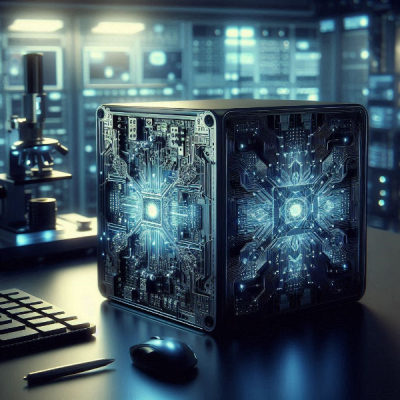
In 1981, American physicist and Nobel Laureate Richard Feynman gave a lecture at the Massachusetts Institute of Technology (MIT) in which he outlined a revolutionary idea. Feynman suggested that the strange physics of quantum mechanics could be used to perform calculations. Quantum computing was born. The illustration here shows what one might have imagined it to be back in 1981 - a lind of science-fiction computer.
Quantum computing is a revolutionary area of computing that uses the principles of quantum mechanics to process information in fundamentally different ways than classical computers. In classical computing, information is processed using bits, which are binary and can represent either a 0 or a 1. In quantum computing, however, the fundamental units of information are called qubits. Qubits can exist in a state of 0, 1, or both simultaneously, thanks to a quantum property called superposition. This allows quantum computers to perform multiple calculations at once.
I am not a physicist or computer engineer, so I don't want to go too deeply into that realm. Reading about this, I see the word "entanglement" and have some memory of Einstein referring to quantum entanglement as "spooky action at a distance." He was skeptical since it seemed to defy the principles of classical physics and his theory of relativity. Einstein doubted entanglement, but modern experiments have confirmed its existence and shown that it is a fundamental aspect of quantum mechanics. In quantum computing, entanglement creates strong correlations between qubits, even when they are far apart.
Entanglement enables quantum computers to solve certain types of complex problems much faster than classical computers by leveraging these interconnected qubits. Quantum computers are particularly well-suited to tasks involving massive datasets, optimization problems, simulations, and cryptography. However, they are still in their early stages of development and face challenges such as error rates, stability, and scalability.
In the same way that AI is already in your daily life - even if you don't notice or acknowledge it - quantum computing could be used in everyday activities. It could revolutionize drug discovery and personalized medicine by simulating molecular interactions at an unprecedented speed, leading to faster development of cures and treatments. By solving complex optimization and learning problems, quantum computers could significantly enhance AI's capabilities, leading to smarter assistants and systems.
Cryptography and cybersecurity's current encryption methods could be broken by quantum computers, but they could also enable quantum-safe encryption, making online transactions and communications more secure. There's good and bad in almost every discovery.
In logistics, smarter traffic systems to more efficient delivery routes, quantum computing could optimize logistics, reducing fuel consumption, travel times, and costs.
And quantum computing could impact improved energy solutions, financial modeling, material design, and many things we haven't even considered yet.
Of course, there are challenges. Qubits are highly sensitive to their environment. Even minor disturbances like temperature fluctuations, vibrations, or electromagnetic interference can cause qubits to lose their quantum state—a phenomenon called decoherence. Maintaining stability long enough to perform calculations is a key challenge. Many quantum computers require extremely low temperatures (close to absolute zero) to operate, as qubits need highly controlled environments. Building and maintaining these cryogenic systems is both expensive and challenging.
Small-scale quantum computers exist, but scaling up to thousands or millions of qubits is a monumental task and requires massive infrastructure, advanced error correction mechanisms, and custom hardware, making them cost-prohibitive for widespread adoption.
On the education side of this, quantum computing sits at the intersection of physics, engineering, computer science, and more. A lack of cross-disciplinary expertise will slow down progress in this field.


 Huang's Law and Moore's Law are concepts primarily associated with the semiconductor industry and technology advancements. However, their principles can be extended and applied to various domains beyond technology.