AI Reinvention: Displaced Professionals in Artisan & Trade Careers

 Modern technology (and its grim efficiencies) has reduced job opportunities for the traditional white-collar population, but the need for artisans --the tradesmen class-- has come on strong.  Training and skills are shifting towards the next generations of the gainfully employed.  Online self-study and instructor-guided courses for topics in HVAC are readily available. These types of trainings are most often created for people whose career path began in the trades.

Artificial Intelligence is transforming industries faster than ever. In 2025, 85 million jobs may be displaced globally  (World Economic Forum). While AI creates new tech roles, many mid-career professionals—accountants, data clerks, paralegals, programmers, and project managers—find themselves displaced with skills seemingly mismatched for the future. A counterintuitive opportunity lies in reviving artisan trades—fields where the human hand, creativity, and craftsmanship remain irreplaceable.

Trades and artisan skills, so far, have been largely resistant to this wave of job takeovers and are adding AI technologies as trade tools. Plumbing, carpentry, welding, and advanced manufacturing require spatial reasoning, adaptive problem-solving, and tactile precision—areas where AI and robotics still struggle. Modern trades use AI as a tool, not a replacement—e.g., welders using AR-guided precision tech or electricians diagnosing systems via IoT sensors.

The good news, for some, in this murky career landscape is that some professionals aren’t starting from zero. Project management, client relations, and analytical skills from corporate roles translate powerfully into trade entrepreneurship, though they have no direct relationship to the skills required to ply a trade. While a former finance analyst may have the budgeting discipline to construct and follow a profitable business plan for home remodeling, that analyst will still need a supply of talent for doing the actual work.

There are programs available as (re)training pathways to the professionally displaced, but they are young, and their career-shifting success is currently unproven

Program Type Resource Types Duration/Cost
Apprenticeships National Electrical Contractors Association (NECA) 2-5 years (paid)
Bootcamps General Assembly (HVAC, Robotics) 3-6 months ($5-15K)
Community Colleges Tennessee Reconnect (free tuition for adults) 1-2 years
Micro-credentials IBM SkillsBuild, Coursera Trade Certificates Weeks to months
Trades Incubators Etsy Maker Grants, Local Makerspaces Mentorship + equipment access

Funding for retraining in these  programs, as well as some financial support for living, is listed as:

  • Pell Grants for Short-Term Programs: Now cover high-quality trade certificates.
  • WIOA Funding: U.S. Workforce Innovation and Opportunity Act funds reskilling for displaced workers.
  • Employer Partnerships: Companies like Siemens and Bosch sponsor "earn-while-you-learn" tracks.

The challenge is both obvious and daunting.  Not only are career paths for entry- and mid-level professional careers at risk, but the need to pivot to new, unfilled, and available careers will be a complicated hill to climb.  This pivot, potentially, is immensely disruptive to the workforce. It may change some of our social constructs as well.  Our hope can be that reskilling displaced workers for trades isn’t a step backward—it’s an economic renaissance. By leveraging existing soft skills, emerging edtech, and a renewed cultural appreciation for craft, we can turn displacement into durability.  Maybe

Computers (and AI) Are Not Managers
doc

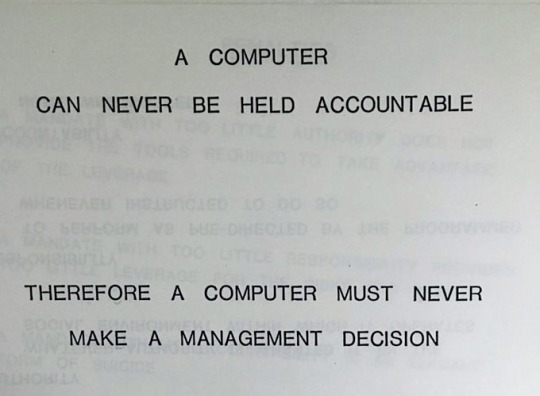
Internal IBM document, 1979 (via Fabricio Teixeira)

I saw the quote pictured above that goes back to 1979 when artificial intelligence wasn't part of the conversation. "A computer must never make a management decision," said an internal document at the big computer player of that time, IBM. The why of that statement is because a computer can't be held accountable.

Is the same thing true concerning artificial intelligence 46 years later?

I suspect that AI is currently being used by management to analyze data, identify trends, and even offer recommendations. But I sense there is still the feeling that it should complement, not replace, human leadership.

Why should AI be trusted in a limited way on certain aspects of decision-making?

One reason that goes back at least 46 years is that it lacks "emotional intelligence." Emotional intelligence (EI or EQ) is about balancing emotions and reasoning to make thoughtful decisions, foster meaningful relationships, and navigate social complexities. Management decisions often require a deep understanding of human emotions, workplace dynamics, and ethical considerations — all things AI can't fully grasp or replicate.

Because AI relies on data and patterns and human management often involves unique situations where there might not be clear precedents or data points, many decisions require creativity and empathy.

Considering that 1979 statement, since management decisions can have far-reaching consequences, humans are ultimately accountable for these decisions. Relying on AI alone could raise questions about responsibility when things go wrong. Who is responsible - the person who used the AI, trained the AI or the AI itself? Obviously, we can't reprimand or fire AI, though we could change the AI we use, and revisions can be made to the AI itself to correct for whatever went wrong.

AI systems can unintentionally inherit biases from the data they're trained on. Without proper oversight, this could lead to unfair or unethical decisions. Of course, bias is a part of human decisions and management too.

Management at some levels involves setting long-term visions and values for an organization. THis goes beyond the realm of pure logic and data, requiring imagination, purpose, and human judgment.

So, can AI handle any management decisions in 2025? I asked several AI chatbots that question. (Realizing that AI might have a bias in favor of AI.) Here is a summary of the possibilities given:

Resource Allocation: AI can optimize workflows, assign resources, and balance workloads based on performance metrics and project timelines.

Hiring and Recruitment: AI tools can screen résumés, rank candidates, and even conduct initial video interviews by analyzing speech patterns and keywords.

Performance Analysis: By processing large datasets, AI can identify performance trends, suggest areas for improvement, and even predict future outcomes.

Financial Decisions: AI systems can create accurate budget forecasts, detect anomalies in spending, and provide investment recommendations based on market trends.

Inventory and Supply Chain: AI can track inventory levels, predict demand, and suggest restocking schedules to reduce waste and costs.

Customer Management: AI chatbots and recommendation engines can handle customer queries, analyze satisfaction levels, and identify patterns in customer feedback.

Risk Assessment: AI can evaluate risks associated with projects, contracts, or business decisions by analyzing historical data and current market conditions.

As I write this in March 2025, the news is full of stories of DOGE and Elon Musk's team using AI for things like reviewing email responses from employees, and wanting to use more AI to replace workers and "improve efficiency."  AI for management is an area that will be more and more in the news and will be a controversial topic for years to come. I won't be around in another 46 years to write the next article about this, but I have the feeling that the question of whether or not AI belongs in management may be a moot point by then.


Fear of Becoming Obsolete

fearful workers

The term FOBO appeared in something I was reading recently. It is the fear of becoming obsolete (FOBO) and it is very much a workplace fear and generally connected to aging workers and anyone who fears that they will be replaced by technology.

Of course, AI is a large part of this fear. It's not a new fear. Workers have always considered that they would be considered obsolete as they aged, especially if they did not have the skills that younger employees brought to the workplace. It has been at least two decades of hearing predictions that robots would replace workers. In fact, that was the case, though not to the levels that were sometimes predicted. Artificial intelligence is less obvious as it makes inroads into our work and outside life.

Employers and workers need to be better at recognizing the ways AI is already here and being used. Approximately four in ten Americans use Face ID to log into at least one app on their phone each day. That is about 136 million people. How many think about that as AI?

If you have an electric vehicle, A.I.-powered systems work to manage the energy output. In your gas-powered car, you very likely use an AI-powered GPS for navigation.  

One survey I saw found that just 44 percent of the global workforce believe they interact today with AI in their personal lives. But when asked if they used GPS maps and navigation, 66 percent said yes. What about predictive product/entertainment suggestions, such as in Netflix and Spotify?  50 percent said yes.  Do you use text editors or autocorrect? A yes from 47 percent. 46 percent use virtual home assistants, such as Alexa and Google Assistant. Even chatbots like ChatGPT and CoPilot - which are less hidden and more proactive for a user - had a 31 percent yes response.

Most of these are viewed as positive uses of AI, but not all uses are viewed as positive or at least are viewed as somewhat negative. One example of that category is the AI not so positive is its use in filling up newsfeeds. Each social media network - Facebook, Twitter, Instagram et al  - has its own A.I.-powered algorithm. It is constantly customizing billions of users’ feeds. You click a like button, or just pause on a post for more than a few seconds,and that information changes your feed accordingly. Plus, the algorithm is made to push certain things to users that were not suggested by your activity but by sponsors or owners. This aspect has been widely criticized since Elon Musk took over Twitter-X, but all the platforms do it to some degree.

Some common applications are both positive and negative. Take the use of artificial intelligence in airports all over the world. It is being used to screen passengers passing through security checkpoints. At least 25 airports across the U.S., including Reagan National in Washington D.C. and Los Angeles International Airport, have started using A.I.-driven facial recognition as part of a pilot project. Eventually, the Transportation Security Administration (TSA) plans to expand the ID verification technology to more than 400 airports. This can speed up your passage through security which is something everyone would love to see, but what else is being done with that data, and will the algorithm flag people for the wrong reasons?

Do you want to push back on FOBO, particularly in the workplace? Some suggestions:
Continuous Learning: Stay curious and keep updating your skills. Whether it’s taking a course, attending workshops, or learning new technologies, continuous education is key.
Networking: Engage with your professional community. Networking can provide insights into industry trends and offer support and advice.
Adaptability: Embrace change and be open to new ideas. Flexibility can help you stay relevant.
Mindset Shift: Focus on your unique strengths and contributions. Everyone has something valuable to offer, and feeling obsolete often stems from undervaluing your skills.
Digital Detox: Sometimes, limiting your exposure to social media and other sources of comparison can reduce feelings of inadequacy.
Seek Feedback: Regularly seek feedback from peers, mentors, and colleagues to understand your areas of improvement and strengths.

Gig Work After Retirement

After retirement, some older workers are turning to gig work to keep busy and sharp, as a lifeline, or as a last resort. So reports Rest of World who spoke to 50 older workers worldwide.

Most gig workers globally are relatively young: Research published in 2021 by the International Labour Organization (ILO), a United Nations agency focused on improving working conditions, puts the average age for delivery workers at 29 and the average age for ride-hailing drivers at 36. But older individuals are turning to gig work, and their numbers are expected to grow in the coming years.

For example, a man in São Paulo drives people at least 12 hours a day, and at 62, he doesn’t see himself stopping anytime soon. He makes roughly 4000 reais ($790) per month after paying off all expenses; it is now his household’s only income. In a country where the monthly minimum wage is 1,412 reais ($273), it’s a good income.

gig work
An unretired gig worker working in a car driven by an unretired gig worker.

I wrote about gig work and "unretirement" on this blog five years ago, and started writing about it 9 years ago on another blog when I decided to do it myself.

The global population of people 65 or older is expected to double by 2050, surpassing 1.6 billion, according to the U.N. At the same time, family units worldwide are transforming, often requiring older people to support themselves for longer. Not all gig workers do it full-time, and for many people (especially younger workers) it supplements other work.

In America, things are different but the trend is still evident. Over the last two decades, the share of the workforce aged 55 or older almost doubled and the government is looking at labor trends like this. By 2028, over a quarter of the workforce will be 55 or older. Inflation has been a factor in forcing retirees back to work. 43 percent of those considering returning to work are doing so because of inflation. One report identifies that older Americans are increasingly turning to the gig economy to supplement their incomes and savings due to its flexibility. Nearly 1 in 3 independent or “gig” workers are over age 55.