Microlearning

There was an unexpected shift to virtual learning triggered by the global pandemic. It's not that virtual hadn't already existed for decades in various formats.
The global shift to virtual education has highlighted the crucial need for effective instructional design, particularly in enhancing student engagement. Traditional long lectures struggle to maintain attention in the digital environment, making the strategic adoption of microlearning important for success.

Microlearning delivers content in small, focused segments, which are far more effective for learners to absorb and retain information. This approach consists of “bite-sized” educational chunks, typically lasting only a few minutes. By delivering short, structured, and fine-grained activities, microlearning aligns with how working memory functions, fitting within the constraints of human cognitive capacity. This technique significantly enhances engagement and reduces cognitive overload, helping to move information from short-term to long-term memory more effectively than traditional, lengthy content.

A major advantage of microlearning is its ability to address the forgetting curve . The forgetting curve demonstrates how humans naturally lose a substantial amount of newly learned information over time unless it's reinforced. Microlearning counteracts this decline through spaced repetition techniques. This involves recalling the same material multiple times over a period, which successfully solidifies the information in long-term memory with each recall.

Furthermore, microlearning enhances online student engagement by allowing students to complete lessons according to their own schedule, rather than a fixed external one. This flexibility enables students to be entirely focused and more engaged in the learning process. Since online learning often happens outside the classroom, microlearning allows for a greater potential for application by integrating learning with real-life experience. Instructors can seamlessly integrate microlearning into online education using various digital tools to incorporate interactive quizzes, short videos, or specific micro lessons that run parallel to the main course, ensuring a more dynamic and interactive experience.


How Verbal Thinking Elevates Learning

student working on mathThe notion of talking to oneself, often dismissed as a mere quirky habit or a sign of preoccupation, is, in fact, a powerful, evidence-based cognitive tool essential for learning, problem-solving, and achieving self-regulation. For educators, understanding and deliberately integrating this "verbal thinking"—known in psychological literature as private speech, self-talk, or self-explanation—into pedagogical practice can unlock deeper comprehension and foster truly independent learners. 

The psychological roots of verbal thinking's benefit trace back most prominently to the work of Soviet psychologist Lev Vygotsky. His socio-cultural theory identifies a critical stage in a child's cognitive development where social communication turns inward to become a robust tool for thinking. Vygotsky outlined a three-stage developmental framework for language: beginning with Social Speech in young children, where language is purely external and used for communicating with others; progressing to Private Speech during the preschool years (ages 3-7), where the child begins to speak aloud to themselves, often in a whisper or mumble, utilizing this overt language as a self-guiding tool for planning, regulating, and controlling their own behavior and problem-solving attempts.

For example, a child engaged in a puzzle might audibly walk themselves through the steps: "First, put the red block here, then the blue block goes on top." This transitional phase ultimately leads to Inner Speech (age 7+), which is the fully internalized, silent verbal thought that most adults use for abstract reasoning, reflection, and sophisticated problem-solving. For educators, the key takeaway from Vygotsky’s work is that overt verbal thinking, or private speech, represents the crucial bridge from externally guided learning—where an adult or peer provides the instruction—to true self-regulation and independent, complex thought. By encouraging students to verbalize their process, teachers are helping them build the necessary internal scaffolding for later, silent, and more sophisticated thinking.

Crucially, verbal thinking doesn't just manage behavior; it fundamentally alters how information is encoded and understood by the brain, supporting both memory and comprehension. Research in memory retrieval highlights a phenomenon known as the Production Effect, which demonstrates that reading or generating information aloud significantly improves its memory retention compared to reading it silently. This memory boost occurs because speaking information aloud engages a greater number of sensory channels simultaneously. The learner uses visual input (seeing the text), verbal/motor input (the physical articulation of the words), and auditory input (hearing the words being spoken). This richer, multi-modal encoding creates a more distinctive and robust memory trace in the brain, making the information much easier to recall later. This distinctiveness is vital: when a learner produces a word aloud, it stands out against the background of other silently read words, making the item unique in memory. Therefore, simply having students read key definitions, summaries, or steps aloud in a low-stakes environment is a simple, yet highly effective, way for educators to leverage this proven physiological mechanism to strengthen long-term memory.

Perhaps the most powerful cognitive benefit, particularly for complex material, is the deep processing that occurs through self-explanation. This process is not mere repetition; it is the active, conscious act of trying to explain new information by relating it to what one already knows, making necessary inferences, and proactively clarifying any ambiguities. The first benefit here is powerful metacognitive monitoring: when a learner verbalizes a concept, the very act of articulation immediately exposes areas of confusion or "knowledge gaps." If a student struggles to explain a step in a math proof or a scientific concept, the flaw in their understanding is instantly revealed, prompting them to go back and refine their knowledge. This is a critical act of metacognition—the vital process of thinking about one's own thinking. Secondly, self-explanation drives coherence building. Verbalizing forces the student to translate disparate, often fragmented, pieces of information into a coherent, logical structure. They are not just recalling isolated facts but actively constructing a unified mental model of how the concepts interact. This principle is famously embodied by the Feynman Technique—explaining a concept simply as if teaching it to a novice—which serves as a form of high-level, deliberate verbal thinking that ruthlessly exposes the limits of a learner's comprehension.

The idea that talking to yourself out loud is not only "okay" but also an excellent learning technique is satisfying, but as I dug into this research, I recognized things from my college and grad school education courses. Other than the idea that it's not abnormal behavior to talk to yourself, this research is not completely new. I used several of these pedagogies in my teaching.

The challenge for educators, then, is to move verbal thinking from an accidental occurrence to a deliberate, scaffolded learning strategy within the classroom environment. One highly effective technique is the Think-Aloud Strategy, which focuses on teacher modeling. This strategy is used to make the invisible thought process of an expert visible and accessible to students, thereby explicitly teaching them how to engage in effective self-talk. To implement this, the teacher must first explicitly state the goal: "I’m going to show you how a skilled reader or problem-solver thinks by saying my thoughts out loud." Then, as the teacher reads a complex passage, works through a mathematical equation, or analyzes a primary source, they must stop frequently to verbalize their internal dialogue. This might involve using strategic planning language like, "I'm thinking I should use the quadratic formula here because the equation is set to zero," or demonstrating monitoring and correction by saying, "That word, 'ephemeral,' sounds like it means brief, so I’m going to pause and look that up to make sure I understand the context," or making connections: "The author just described the main character as restless. That connects to the idea I read earlier about his lack of a stable job. I wonder if this will lead to him leaving town." Once modeled, the teacher must transition students to practicing the strategy, perhaps through paired activities known as Reciprocal Think-Alouds, before expecting independent use.

A second practical technique is the Self-Explanation Prompt. This method strategically inserts verbalization breaks into a learning task to force metacognitive reflection and is particularly useful in technical subjects. Implementation begins by identifying key moments in a text, problem set, or lab procedure where a deeper understanding is absolutely necessary before the student can proceed. At these pause points, the teacher provides students with specific open-ended questions they must answer aloud to themselves or in a brief reflection journal. Prompts should be targeted to specific cognitive functions, such as focusing on rationale ("Why did I choose this variable to isolate?"), demanding synthesis ("What is the main idea of this section in my own words?"), or explicitly asking for a connection ("How does this new concept relate to what we learned last week?"). For maximum impact, teachers should then encourage a "Think-Pair-Share" approach where students must first explain their logic to a partner, which solidifies the idea and provides practice in articulation before the whole class moves on.

Finally, the "Teach It Back" Method is a form of high-stakes verbal thinking rooted in the pedagogical principle that to teach a concept is to truly master it. In this strategy, a student is assigned the role of briefly "teaching" a key concept, a section of the reading, or a part of the homework to a small group, to the class, or even to an imaginary audience. The critical instruction given to the student is to explain the topic as simply as possible, perhaps using an analogy, metaphor, or non-technical language if appropriate. The student must translate complex, academic language into straightforward, accessible terms, which serves as the ultimate test of their own comprehension. The teacher should provide specific feedback not only on the accuracy of the content but also on the clarity and logical structure of the explanation, reinforcing the importance of effective verbal articulation as a measure of understanding. By integrating these verbal thinking strategies—modeling, prompting, and teaching back—educators are not just improving a single study skill; they are building the core components of the resilient and self-regulated learner, equipping students with the tools for lifelong, independent cognitive growth.

SOURCES
Vygotsky, L. S. (1978). Mind in society: The development of higher psychological processes. Harvard University Press. (This source is foundational for the concepts of Private Speech and its role in Self-Regulation.)

MacLeod, C. M. (2011). The production effect: Better memory as a consequence of saying aloud during study. Applied Cognitive Psychology, 25(2), 195–204. (This research provides the physiological basis for the Production Effect and memory benefits.)

Chi, M. T. H. (2013). Self-explanation: The effects of talking aloud or writing on learning. Topics in Cognitive Science, 5(1), 1–4. (This source details the mechanism and benefits of Self-Explanation for deep comprehension.)

Berk, L. E. (1992). The role of private speech in the development of mental processes. Psychological Review, 99(4), 779–795. (This provides contemporary developmental research supporting and elaborating on Vygotsky’s observations of private speech.)

AI Agents

ai assistant

AI agents are something of concern for OpenAI, Google, and any other players. "AI agents" are software programs designed to perform specific tasks or solve problems by using artificial intelligence techniques. These agents can work autonomously or with minimal human intervention, and they're capable of learning from data, making decisions, and adapting to new situations.

Gartner suggests that agentic AI is the most important strategic technology for 2025 and beyond. The tech analyst predicts that, by 2028, at least 15% of day-to-day work decisions will be taken autonomously through agentic AI, up from 0% in 2024. Does that excite or frighten you?

They can automate processes, analyze data, and interact with users or other systems to achieve specific goals. You probably already interact with them in applications (Siri or Alexa), customer service chatbots, and recommendation systems (Netflix or Amazon). They may be less obvious to you when using an autonomous vehicle or a financial trading system.

There are many categories into which we might place these agents because there are different types of AI agents, each with unique capabilities and purposes:

Here are some possible categorizations:

Reactive agents respond to specific stimuli and do not have a memory of past events. They work well in environments with clear, predictable rules.

Model-based agents have a memory and can learn from past experiences. They use this knowledge to predict future events and make decisions.

Goal-based agents are designed to achieve specific goals. They use planning and reasoning techniques to determine the best actions to take to reach their objectives.

Utility-based agents consider multiple factors and choose actions that maximize their overall utility or benefit. They can balance competing goals and make trade-offs.

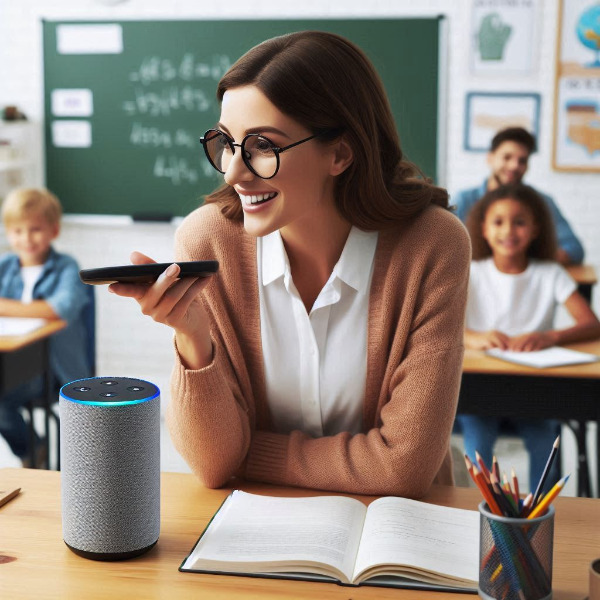
Teacher using AI assistant
Learning agents can improve their performance over time by learning from their experiences. They use techniques like machine learning to adapt to new situations and improve their decision-making abilities.You could also categorize agents in other ways, for example, in an educational contex.

For personalized learning, agents can adapt educational content to meet individual students' needs, learning styles, and pace. By analyzing data on students' performance and preferences, AI can recommend personalized learning paths and resources. In a related way, intelligent tutoring systems can provide one-on-one tutoring by offering explanations, feedback, and hints the way that a human tutor might. They might even be able to create more inclusive learning environments by providing tools like speech-to-text, text-to-speech, and translation services, ensuring that all students have access to educational content. By analyzing students' performance data, they could identify at-risk students and provide early interventions to help them succeed.

AI agents can automate administrative tasks for faculty, such as grading, attendance tracking, and scheduling, freeing up educators' time to focus more on teaching and interacting with students.

Agents can "assist" in creating educational materials. I would hope faculty would be closely monitoring AI creation of tests, quizzes, lesson plans, and interactive simulations.

Though I see predictions of fully AI-powered virtual classrooms that can facilitate remote learning, I believe this is the most distant application - and probably the one that most makes faculty apprehensive.