Your AI Is Not Free

AI manThe phrase that if an app is free, you are the product means that when an app doesn’t charge you money, it usually makes money from you instead. They do that mainly by collecting your data or selling your attention to advertisers.

If that is true, then how is AI changing what that means? It is a question that deserves several posts here to really answer.

Your behavior, preferences, and time become what is being monetized. Your data becomes the product. Free apps often gather your demographics, browsing or in-app behavior, location, interests, and habits. This information is then used to target ads or sold to third parties.

The addictive nature of app design keeps you scrolling, tapping, or watching so they can show you ads. You pay with time, not dollars. “Free” is a business model, not a gift.

I will give these companies a nod that running an app costs money (servers, engineers, storage). If you are not paying, the company must earn revenue another way. Ad-free options are becoming more common as a premium. You have probably noticed that on apps and also on video streaming services. You thought that paying for Amazon Prime meant no ads on the videos. Wrong. Free is often an illusion.

In the world of AI, the difference between free and paid tiers is more than a matter of convenience. It is also about identity and privacy.

Privacy becomes the hidden cost. Data is currency. Companies track you across apps and devices, build detailed behavioral profiles, and use algorithms to influence what you see. This raises concerns about autonomy and consent.

Is there no stopping them? As long as you agree to their terms, they have a lot of power. BUT you can read those terms and privacy settings more carefully. (They rely on the fact that many users don't read the terms or adjust their settings at all.) Educate yourself and understand how digital ecosystems make money. You can choose paid or privacy-focused alternatives. And you can remove the app entirely from your life.

I see comparisons of using AI to using social media platforms. I don't think AI data is the same as social media data. Social media platforms monetize your attention. The longer you scroll, the more ads they can show. AI chatbots operate on a different axis. Your prompts aren’t just content; they’re training signals. They reveal how people think, what they struggle with, what they’re curious about, and how they phrase questions. Maybe it is anonymized (a good thing) but it is still valuable and often sensitive data.

Alarmist articles will remind you that many free AI chatbots use your prompts, your corrections, and your uploaded files. They have that photo of your family that you let them enhance. What will they do with what you give them? I can't answer that as of now, and certainly not for the future. I know that your conversation history is used to train or fine-tune future versions of the model. Hey, you are part of the product pipeline - but don't expect to be paid for your contributions.

I also concede that the business model matters and that different AI companies monetize differently. For example, Microsoft provides its own privacy commitments and policies, and those govern how your data is handled. For details, they always direct users to their Privacy Statement.

Here are 4 business models currently out there:
Ad-supported = Your attention is monetized.
Freemium = Free tier gathers usage; paid tier subsidizes development.
Enterprise licensing = Your data may be isolated; the company earns from businesses.
Open source =  The model is free; the company may sell hosting or support.

So "if an app is free, you are the product" still applies, but not always in the same way. When an AI tool is free, you’re not just the product — you’re also the collaborator. You’re an unpaid teacher, tester, and a source of fuel for improvement.

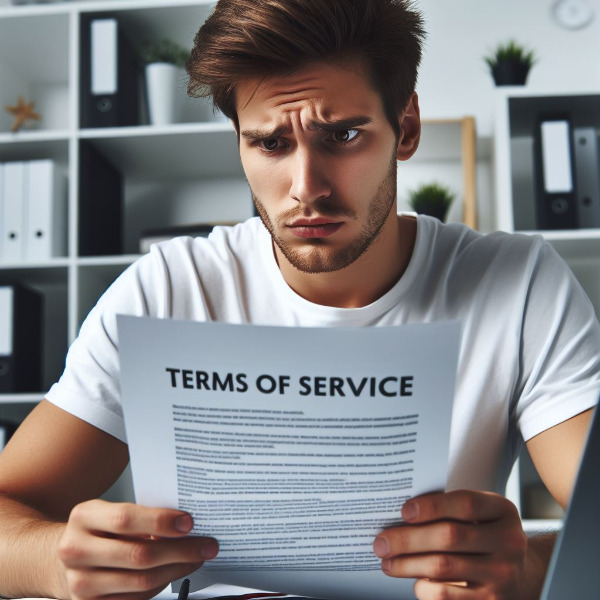
Terms of Service

those confusing terms of serviceTerms of service. That information you tend to avoid reading. Good example: Google's newly updated terms of service, which I found out about in an email last week. I decided to read them.

Their updated terms opens with "We know it’s tempting to skip these Terms of Service, but it’s important to establish what you can expect from us as you use Google services, and what we expect from you. These Terms of Service reflect the way Google’s business works, the laws that apply to our company, and certain things we’ve always believed to be true. As a result, these Terms of Service help define Google’s relationship with you as you interact with our services."

Here are a few items I noted:
Some things considered to be abuse on the part of users includes accessing or using Google services or content in fraudulent or deceptive ways, such as:
phishing
creating fake accounts or content, including fake reviews
misleading others into thinking that generative AI content was created by a human
providing services that appear to originate from you (or someone else) when they actually originate from us
providing services that appear to originate from us when they do not
using our services (including the content they provide) to violate anyone’s legal rights, such as intellectual property or privacy rights
reverse engineering our services or underlying technology, such as our machine learning models, to extract trade secrets or other proprietary information, except as allowed by applicable law
using automated means to access content from any of our services in violation of the machine-readable instructions on our web pages (for example, robots.txt files that disallow crawling, training, or other activities)
hiding or misrepresenting who you are in order to violate these terms
providing services that encourage others to violate these terms

Take that second item I highlighted about misleading others into thinking that generative AI content was created by a human, Does that mean that if I use their generative AI or some other provider's AI to help write a blog post that I put here with my name that I am violating their terms of service?

Though I would say that Google's Terms of Service is written in plain langauage that most readers should be able to understand, the implications of some of the terms are much harder to interpret.

NOTE: The Google Terms of Service (United States version) that I reference are effective May 22, 2024.
View
Archived versions and  Download a PDF


Folksonomy Taxonomy Fauxonomy

I wrote about the topic of folksonomy back in 2006. The word joins folk + taxonomy and refers to the collaborative but informal way in which information is being categorized on the web.

As users, usually voluntarily, assign keywords or "tags" (from hashtags) to images, posts or data, a folksonomy emerges. These things are found on sites that share photographs, personal libraries, bookmarks, social media and blogs which often allow tags for each entry.

Taxonomy is a more familiar and very formal process. You are probably familiar with scientific classifications and might have studied the taxonomy of organisms. Remember learning about Domain, Kingdom, Phylum, Class, Order, Family, Genus, and Species? As an avid gardener, i encounter the taxonomy of plants regularly.

There are taxonomies that are not considered "scientific" because they include sociological factors. In academia, many of us know Bloom's Taxonomy - the classification of educational objectives and the theory of mastery learning.

Non-scientific classification systems are referred to as folk taxonomies, but the academic community does not always accept folksonomy into either area. In fact, some who support scientific taxonomies have dubbed folksonomies as fauxonomies.

Others see folksonomy as a part of the path to creating a semantic web. It's a web that contains computer-readable metadata that describes its content. This metadata (tags) allows for precision searching.

If you have ever tried to get a group of readers or graders to agree on how to evaluate writing using a rubric, you might understand how hard it would be to get the creators of web content tag content in a consistent and reliable way.

Some examples of standards for tagging include Dublin Core and the RSS file format used for blogs and podcasts. All of this really grew out of the use of XML. Extensible Markup Language (XML) is a general-purpose markup language (as is HTML) that was at least partially created to facilitate the sharing of data across different systems, particularly systems connected via the Internet.

Folksonomies do have advantages. They are user-generated and therefore easy (inexpensive) to implement. Metadata in a folksonomy (for example, the photo tags on Flickr.com) comes from individuals interacting with content not administrators at a distance. This type of taxonomy conveys information about the people who create the tags and a kind of user community portrait may emerge. Some sites allow you to then link to other content from like-minded taggers. (We have similar taste in photos or music, so let's check out each others links.) Users become engaged.

There are problems: idiosyncratic tagging actually makes searches LESS precise. Some people post items and add many hashtags in the hopes of having their content found in a search on that tag. They may even add irrelevant tags for that reason. Tagging your post with the names of currently popular people or adding "free, nude, realestate, vacations" even though none of those are relevant to your content might cause someone searching for those things to find your content - but that person is likely to be unhappy at landing at your place.


Is Your Phone Smarter Than You Yet?

IoT
      Image by Chen from Pixabay

Predictions can be interesting, but people rarely look back at ones to see if they were correct. I wrote a post titled "In 4 Years Your Phone Will Be Smarter Than You (and the rise of cognizant computing)"  It has more than 969,000 views since I posted it in November 2013. Next year will be 10 years since that prediction. Is your phone smarter than you yrt?

That was not my prediction but it was an analysis from the market research firm Gartner. They weren't as concerned with hardware as with data and cloud computational ability. I said then that phones will appear smarter than you IF you equate smarts with being able to recall information and make inferences. Surely, those two things are part of being "smart" but not all of it.

"Smart" is also defined sometimes as being knowledgeable of something especially through personal experience, mindful, even cognizant of the potential dangers. Cognizant is a synonym for awareness. I have bee reading a lot about artificial intelligence lately. While cognizant computing does use algorithms to anticipate users' needs, dpong so doesn't approach actual "consciousness."

If an app has my browsing history, purchase records, financial information, and whatever is available somewhere on the cloud (known or unbeknownst to me) it can be pretty good at predicting somethings about me.

Cognitive computing isn't the same thing, though so much of all this seems to overlap. Cognitive computing (part of cognitive science) and attempts to simulate the human thought process.

As I said, these things overlap, at least to someone like myself who isn't really working in these fields. Maybe it makes a kind of sense that AI, cognitive and cognizant computing, signal processing, machine learning, natural language processing, speech and vision recognition, human-computer interaction and probably a dozen I'm forgetting. I suspect that all these things will converge at some point in the future to create the ultimate AI.

I don't see as many mentions these days to the Internet of things (IoT) as I did a decade ago. Internet-enabled objects exist in my home as "appliances." This morning I was checking my Ecobee app which is my wireless home energy monitor. I assume that it is already and will in the future be better at a kind of cognizant device that monitors my home environmental conditions and make adjustments based on my settings and the three sensors that monitor our activity. It knows that no one is upstairs and so drops the temperature there - though no lower than what I have told it. It also suggests changes to my settings and reminds me to change the filter every three months. I always di that on the solstices and equinoxes anyway but if I miss that date by a day or two, it adjust the next change accordingly. Quite a fussy and OCD device. It could connect to my Alexa devices but I haven't allowed that yet. Maybe one day it will just do it on its own and tell me "It's for your own good, Kenneth."