A New AI Hub from Microsoft & The Open University

This AI Hub from Microsoft & The OU is a collection allowing you to explore free, accessible courses designed to build your confidence and skills in artificial intelligence. Whether you’re just starting out or looking to deepen your knowledge, the AI Hub will support your learning journey with expert-led, trusted, easy-to-use resources created by The OU and Microsoft.

Not labeled as a MOOC (a term that seems to have fallen away in the past decade) it is a similar kind of open course, not for credit but for learning.

AI Fluency is a beginner-friendly learning path designed to build confidence and understanding in artificial intelligence. Through a series of practical sessions, learners explore AI fundamentals, generative AI, responsible AI principles, and the real-world impact of AI across work, accessibility, and society. The course also introduces Microsoft Copilot, showing how AI tools can support creativity, productivity, and everyday problem solving. 
Suitable for students, professionals, and leaders alike, AI fluency helps demystify AI and equips learners with the knowledge to engage with AI technologies thoughtfully, responsibly, and effectively.

Work Smarter with AI is a 65 minute, one module, learning path to help you work better and unleash your creativity with Microsoft Copilot. In this learning path, you'll explore how to use Microsoft Copilot to help you research, find information, and generate effective content. 
Prerequisites: Familiarity with Microsoft productivity applications, like Word, Excel, Outlook, and PowerPoint.
Andragogy and Microlearning

learnersI have referenced microlearning in earlier posts, but I want to say more about how microlearning works effectively with andragogy (adult learning theory), which differs from the more commonly heard pedagogy (children).

Microlearning provides the flexible format and focused content that perfectly complements the goal-oriented, self-directed nature of the adult learner. (Not that children don't want their learning to be self-directed, but they are less capable of doing that on their own.) Andragogy principles are strengthened by microlearning's ability to combat the forgetting curve. Microlearning often incorporates spaced repetition through short, periodic knowledge checks or quizzes. By revisiting core concepts in brief intervals, the information is reinforced, helping to move the content from short-term to long-term memory, which is vital for busy adult learners who may not have dedicated study time.

Adult learners, by definition, value autonomy and prefer to be self-directed in their education. So, microlearning modules are typically accessed on demand via mobile devices or learning platforms. Much of that learning occurs outside of traditional learning spaces. This allows adults to choose what they need to learn and when it fits into their busy personal and professional schedules, fully supporting their desire to take control of their learning path.

Adults are motivated to learn when the content is immediately relevant and can be applied to solve a real-life problem or job-related task. Each microlearning module is intentionally designed to focus on one specific learning objective. That might be "how to change the blade on a lawn mower," but also  'how to execute X function in the software." This problem-centered focus provides just-in-time training, ensuring the information is practical, immediately useful, and valuable for their current role.

Adults are most ready to learn when they encounter a specific need or challenge in their work or life.

Younger learners are more likely to accept the "authority" of the teacher that something needs to be learned at this time, even if they don't see a need for it themselves. It's not that younger learners don't sometimes do the same kind of "just in time," self-motivated learning. They might search for a video on how to do something when starting a task. But this is more likely to occur with older learners.

Adult learners have accumulated a wealth of experience and are often battling time shortages. They need efficient learning that builds on what they already know. Microlearning usually respects the adult's time by eliminating filler and focusing only on the "need-to-know" core information. 

AI chatbots are certainly the latest form of just-in-time microlearning that is being used outside classrooms. Its use is not unlike someone earlier looking for a help video on YouTube, but it is incredibly fast and personalized.  

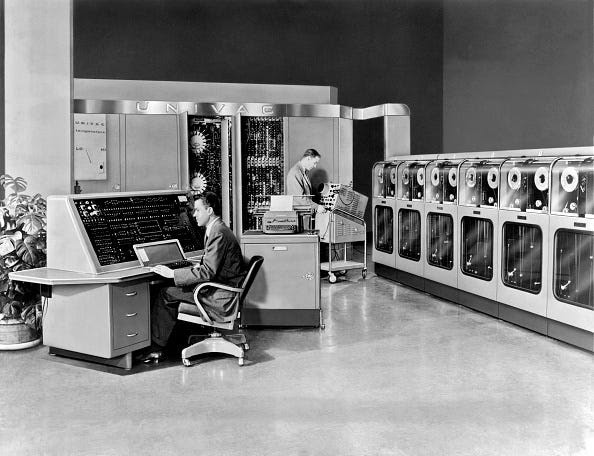
UNIVAC 1951

You may have heard the advice to speakers to open with a joke, so here we go.
A bunch of scientists created a huge machine capable of complex calculations and called it UNIVAC. Eager to test their invention, they asked it, “Is there a God?”The vacuum tubes hummed, and the tape spools spun for several minutes. Finally, the machine spat out a little card, on which was written, “THERE IS NOW.”

That's an old joke, but it seems fresh in this "Intelligence Age" of artificial intelligence and fears of a singularity. In this time of AI and having a computer in the palm of our hand, it is interesting to consider what was happening in tech history back in 1951. That was when the Remington Rand Corporation signed a contract to deliver the first UNIVAC computer to the U.S. Census Bureau.

UNIVAC room

UNIVAC I (which stands for Universal Automatic Computer) took up 350 square feet of floor space — about the size of a one-car garage — and was the first American commercial computer. It was designed for the rapid and relatively simple arithmetic calculation of numbers needed by businesses, rather than the complex calculations required by the sciences. It was intended to compete against IBM’s punch card-reading computers, but UNIVAC read magnetic tapes, not punch cards, so a special “card to tape converter” had to be designed.

Though the government contract was signed and a ceremony held on March 31, the computer wasn’t actually delivered until the following December. There was only one UNIVAC I, and Remington Rand wanted to use it for demonstration purposes. They asked for and received time to build a second computer.

The government was the first big customer of the UNIVACs, with subsequent models going to the Air Force, the Army Map Service, the Atomic Energy Commission, and the Navy.

The computer first came to the notice of the general public in 1952, when CBS used one to predict the outcome of the presidential election. UNIVAC correctly picked Eisenhower and predicted his electoral count within 1 percent, but the network didn’t release the results until after the election was called, so as not to affect the outcome.

The first commercial sale was to General Electric, for their Appliance Division, followed soon after by the Metropolitan Life Insurance Company, in 1954.

There were 46 UNIVAC I’s built and delivered, in all.

The AI Doc: Or How I Became an Apocaloptimist

If you’ve found yourself both fascinated and/or unsettled by the accelerating pace of artificial intelligence, THE AI DOC; OR HOW I BECAME AN APOCALOPTIMIST offers one way to lean into that tension rather than avoid it.

This week it was my film for the Film Matinee Club with Montclair Film. Our discussion after viewing the film was "spirited." Artificial intelligence certainly pushes people's intellectual and emotional buttons.

Directed by Daniel Roher and Charlie Tyrell and hosted by Roher. It is about making a documentary, and it is about AI, and it is also a personal narrative centered on Roher’s own fears about the future, especially as he and his wife contemplate having their first child in an AI-driven world.

Across all sources, the documentary’s expert roster includes top AI CEOs, pioneering researchers, alignment and ethics leaders, and public intellectuals. The film intentionally spans “doomers,” “optimists,” and “apocaloptimists,” giving a wide-angle view of the AI debate.

Roher becomes an Apocal (as in apocalypse) optimist because (spoiler alert) as he learns more and understands AI's capabilities, he begins to see more positive possibilities. And yet the answer to whether AI will cause the end of us or make our lives very much improved is still an open question. Even the experts don't know no matter what side they take on the AI debate.

The film very deliberately does not settle on a single answer about the future of AI. The film’s whole structure is built around the tension between optimism and existential risk, and it ends by embracing that unresolved state rather than resolving it./p>