UNIVAC 1951

You may have heard the advice to speakers to open with a joke, so here we go.
A bunch of scientists created a huge machine capable of complex calculations and called it UNIVAC. Eager to test their invention, they asked it, “Is there a God?”The vacuum tubes hummed, and the tape spools spun for several minutes. Finally, the machine spat out a little card, on which was written, “THERE IS NOW.”

That's an old joke, but it seems fresh in this "Intelligence Age" of artificial intelligence and fears of a singularity. In this time of AI and having a computer in the palm of our hand, it is interesting to consider what was happening in tech history back in 1951. That was when the Remington Rand Corporation signed a contract to deliver the first UNIVAC computer to the U.S. Census Bureau.
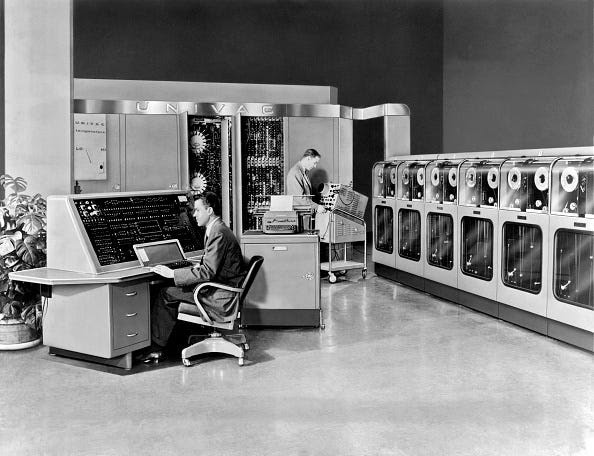
UNIVAC room

UNIVAC I (which stands for Universal Automatic Computer) took up 350 square feet of floor space — about the size of a one-car garage — and was the first American commercial computer. It was designed for the rapid and relatively simple arithmetic calculation of numbers needed by businesses, rather than the complex calculations required by the sciences. It was intended to compete against IBM’s punch card-reading computers, but UNIVAC read magnetic tapes, not punch cards, so a special “card to tape converter” had to be designed.

Though the government contract was signed and a ceremony held on March 31, the computer wasn’t actually delivered until the following December. There was only one UNIVAC I, and Remington Rand wanted to use it for demonstration purposes. They asked for and received time to build a second computer.

The government was the first big customer of the UNIVACs, with subsequent models going to the Air Force, the Army Map Service, the Atomic Energy Commission, and the Navy.

The computer first came to the notice of the general public in 1952, when CBS used one to predict the outcome of the presidential election. UNIVAC correctly picked Eisenhower and predicted his electoral count within 1 percent, but the network didn’t release the results until after the election was called, so as not to affect the outcome.

The first commercial sale was to General Electric, for their Appliance Division, followed soon after by the Metropolitan Life Insurance Company, in 1954.

There were 46 UNIVAC I’s built and delivered, in all.
The AI Doc: Or How I Became an Apocaloptimist

If you’ve found yourself both fascinated and/or unsettled by the accelerating pace of artificial intelligence, THE AI DOC; OR HOW I BECAME AN APOCALOPTIMIST offers one way to lean into that tension rather than avoid it.

This week it was my film for the Film Matinee Club with Montclair Film. Our discussion after viewing the film was "spirited." Artificial intelligence certainly pushes people's intellectual and emotional buttons.

Directed by Daniel Roher and Charlie Tyrell and hosted by Roher. It is about making a documentary, and it is about AI, and it is also a personal narrative centered on Roher’s own fears about the future, especially as he and his wife contemplate having their first child in an AI-driven world.

Across all sources, the documentary’s expert roster includes top AI CEOs, pioneering researchers, alignment and ethics leaders, and public intellectuals. The film intentionally spans “doomers,” “optimists,” and “apocaloptimists,” giving a wide-angle view of the AI debate.

Roher becomes an Apocal (as in apocalypse) optimist because (spoiler alert) as he learns more and understands AI's capabilities, he begins to see more positive possibilities. And yet the answer to whether AI will cause the end of us or make our lives very much improved is still an open question. Even the experts don't know no matter what side they take on the AI debate.

The film very deliberately does not settle on a single answer about the future of AI. The film’s whole structure is built around the tension between optimism and existential risk, and it ends by embracing that unresolved state rather than resolving it./p>

Nate Silver On Why Social Media Has Become a Freak Show

Nate Silver is an American statistician, author, and professional poker player who transformed the landscape of political and sports analysis through probabilistic modeling. Silver first gained prominence in the early 2000s by developing PECOTA, a system for forecasting Major League Baseball player performance. He soon applied these "sabermetric" techniques to politics, founding the influential site FiveThirtyEight in 2008. He famously cemented his reputation by correctly predicting the presidential winner in 49 states that year. Following his departure from ABC News in 2023, Silver returned to his independent roots by launching the Silver Bulletin on Substack. As of 2026, he remains a central figure in election forecasting, providing real-time data modeling for the current midterm cycle. His work has shifted toward a broader exploration of risk; his 2024 book, On the Edge: The Art of Risking Everything, examines the high-stakes world of professional gambling, crypto, and venture capital.

Here is a recent post of his about social media, focusing on the evolution (devolution) of Twitter to X.

The content that gets “engagement” on Twitter is mostly complete crap

And yet, while Facebook is now almost completely irrelevant to the political discourse, that isn’t quite true for Twitter. Google search traffic in the U.S. for the precise term “twitter” is down quite a lot, but that’s not fair to X because the platform now has a new name. Broader traffic for search topics related to Twitter/X is also down, by more than half relative to the peak in late 2012. But the recent decline has been more gradual: about 20 percent as compared to two years ago. That seems to track with other third-party data showing a slow-but-steady decline in Twitter engagement, though nobody can be quite sure since X is no longer a public company.

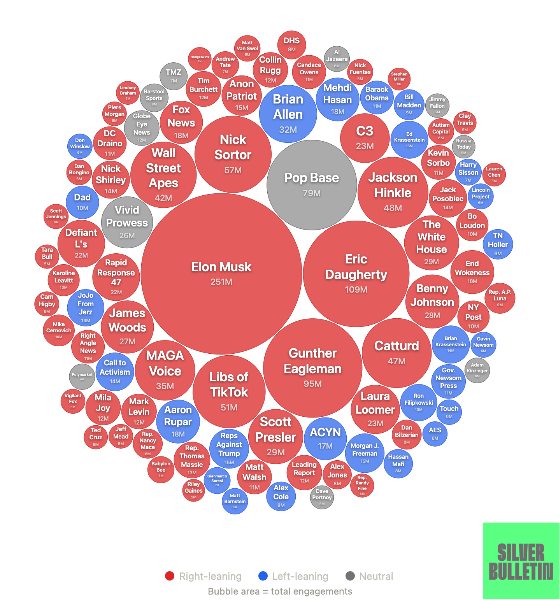
It’s not hard to notice that Twitter has become extremely right-leaning. But I’d argue there’s an equally important trend: the top accounts are of incredibly low quality. Elon, with the algorithmic boost he built in for himself, is at the eye of the storm, of course. But “Catturd” literally gets far more engagement than the New York Times, for instance.

Here's the graphic Silver made using Claude AI to show what's hot on X this year.

bubble chart

Twitter accounts with the most engagement so far in 2026

Your AI Is Not Free

AI manThe phrase that if an app is free, you are the product means that when an app doesn’t charge you money, it usually makes money from you instead. They do that mainly by collecting your data or selling your attention to advertisers.

If that is true, then how is AI changing what that means? It is a question that deserves several posts here to really answer.

Your behavior, preferences, and time become what is being monetized. Your data becomes the product. Free apps often gather your demographics, browsing or in-app behavior, location, interests, and habits. This information is then used to target ads or sold to third parties.

The addictive nature of app design keeps you scrolling, tapping, or watching so they can show you ads. You pay with time, not dollars. “Free” is a business model, not a gift.

I will give these companies a nod that running an app costs money (servers, engineers, storage). If you are not paying, the company must earn revenue another way. Ad-free options are becoming more common as a premium. You have probably noticed that on apps and also on video streaming services. You thought that paying for Amazon Prime meant no ads on the videos. Wrong. Free is often an illusion.

In the world of AI, the difference between free and paid tiers is more than a matter of convenience. It is also about identity and privacy.

Privacy becomes the hidden cost. Data is currency. Companies track you across apps and devices, build detailed behavioral profiles, and use algorithms to influence what you see. This raises concerns about autonomy and consent.

Is there no stopping them? As long as you agree to their terms, they have a lot of power. BUT you can read those terms and privacy settings more carefully. (They rely on the fact that many users don't read the terms or adjust their settings at all.) Educate yourself and understand how digital ecosystems make money. You can choose paid or privacy-focused alternatives. And you can remove the app entirely from your life.

I see comparisons of using AI to using social media platforms. I don't think AI data is the same as social media data. Social media platforms monetize your attention. The longer you scroll, the more ads they can show. AI chatbots operate on a different axis. Your prompts aren’t just content; they’re training signals. They reveal how people think, what they struggle with, what they’re curious about, and how they phrase questions. Maybe it is anonymized (a good thing) but it is still valuable and often sensitive data.

Alarmist articles will remind you that many free AI chatbots use your prompts, your corrections, and your uploaded files. They have that photo of your family that you let them enhance. What will they do with what you give them? I can't answer that as of now, and certainly not for the future. I know that your conversation history is used to train or fine-tune future versions of the model. Hey, you are part of the product pipeline - but don't expect to be paid for your contributions.

I also concede that the business model matters and that different AI companies monetize differently. For example, Microsoft provides its own privacy commitments and policies, and those govern how your data is handled. For details, they always direct users to their Privacy Statement.

Here are 4 business models currently out there:
Ad-supported = Your attention is monetized.
Freemium = Free tier gathers usage; paid tier subsidizes development.
Enterprise licensing = Your data may be isolated; the company earns from businesses.
Open source =  The model is free; the company may sell hosting or support.

So "if an app is free, you are the product" still applies, but not always in the same way. When an AI tool is free, you’re not just the product — you’re also the collaborator. You’re an unpaid teacher, tester, and a source of fuel for improvement.