Quicksearch Your search for microlearning returned 5 results:

Andragogy and Microlearning
learnersI have referenced microlearning in earlier posts, but I want to say more about how microlearning works effectively with andragogy (adult learning theory), which differs from the more commonly heard pedagogy (children).

Microlearning provides the flexible format and focused content that perfectly complements the goal-oriented, self-directed nature of the adult learner. (Not that children don't want their learning to be self-directed, but they are less capable of doing that on their own.) Andragogy principles are strengthened by microlearning's ability to combat the forgetting curve. Microlearning often incorporates spaced repetition through short, periodic knowledge checks or quizzes. By revisiting core concepts in brief intervals, the information is reinforced, helping to move the content from short-term to long-term memory, which is vital for busy adult learners who may not have dedicated study time.

Adult learners, by definition, value autonomy and prefer to be self-directed in their education. So, microlearning modules are typically accessed on demand via mobile devices or learning platforms. Much of that learning occurs outside of traditional learning spaces. This allows adults to choose what they need to learn and when it fits into their busy personal and professional schedules, fully supporting their desire to take control of their learning path.

Adults are motivated to learn when the content is immediately relevant and can be applied to solve a real-life problem or job-related task. Each microlearning module is intentionally designed to focus on one specific learning objective. That might be "how to change the blade on a lawn mower," but also  'how to execute X function in the software." This problem-centered focus provides just-in-time training, ensuring the information is practical, immediately useful, and valuable for their current role.

Adults are most ready to learn when they encounter a specific need or challenge in their work or life.

Younger learners are more likely to accept the "authority" of the teacher that something needs to be learned at this time, even if they don't see a need for it themselves. It's not that younger learners don't sometimes do the same kind of "just in time," self-motivated learning. They might search for a video on how to do something when starting a task. But this is more likely to occur with older learners.

Adult learners have accumulated a wealth of experience and are often battling time shortages. They need efficient learning that builds on what they already know. Microlearning usually respects the adult's time by eliminating filler and focusing only on the "need-to-know" core information. 

AI chatbots are certainly the latest form of just-in-time microlearning that is being used outside classrooms. Its use is not unlike someone earlier looking for a help video on YouTube, but it is incredibly fast and personalized.  

Microlearning

There was an unexpected shift to virtual learning triggered by the global pandemic. It's not that virtual hadn't already existed for decades in various formats.
The global shift to virtual education has highlighted the crucial need for effective instructional design, particularly in enhancing student engagement. Traditional long lectures struggle to maintain attention in the digital environment, making the strategic adoption of microlearning important for success.

Microlearning delivers content in small, focused segments, which are far more effective for learners to absorb and retain information. This approach consists of “bite-sized” educational chunks, typically lasting only a few minutes. By delivering short, structured, and fine-grained activities, microlearning aligns with how working memory functions, fitting within the constraints of human cognitive capacity. This technique significantly enhances engagement and reduces cognitive overload, helping to move information from short-term to long-term memory more effectively than traditional, lengthy content.

A major advantage of microlearning is its ability to address the forgetting curve . The forgetting curve demonstrates how humans naturally lose a substantial amount of newly learned information over time unless it's reinforced. Microlearning counteracts this decline through spaced repetition techniques. This involves recalling the same material multiple times over a period, which successfully solidifies the information in long-term memory with each recall.

Furthermore, microlearning enhances online student engagement by allowing students to complete lessons according to their own schedule, rather than a fixed external one. This flexibility enables students to be entirely focused and more engaged in the learning process. Since online learning often happens outside the classroom, microlearning allows for a greater potential for application by integrating learning with real-life experience. Instructors can seamlessly integrate microlearning into online education using various digital tools to incorporate interactive quizzes, short videos, or specific micro lessons that run parallel to the main course, ensuring a more dynamic and interactive experience.


Microlearning

In my years developing online courses starting at the turn of the century, we discovered quickly that students had no interest in recorded 90-minute lectures on tapes, CDs, DVDs, and eventually online. They hit the fast-forward button frequently.
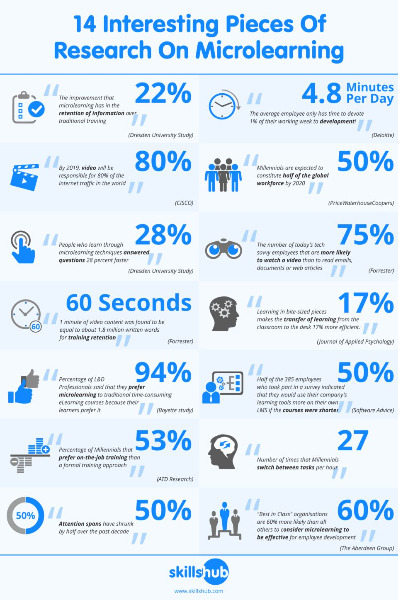
I had learned in my secondary teaching years before my higher ed years that chunking material was essential.  Chunking is the process of breaking down instructional materials into smaller, "bite-sized" pieces and then arranging them in a sequence that makes it easier for your learners to learn the material. Think of how we write phone numbers: 800-289-9246 rather than 8002899246. We do it for dates, we make categories, chapters, heading, subheadings, menus.

The more current term for this seems to be "microlearning" which is used in education and professional development. These short, focused bursts of learning, are often delivered in the form of videos. Proponents will say that this is also effective for time-poor and attention-deficient learners, though that is arguable. 

We know that video accounts for the vast majority of Internet traffic. Of course, it's not all learning. In fact, much of it is entertainment, but educators can learn from how entertainment uses video and media. All those short clips from late-night talk shows or Saturday Night Live get far more views than would a full version of the show.

The effectiveness of microlearning depends on a range of factors: the quality of the materials being delivered, the context in which they are being consumed, and the learning objectives of the individual.

Microlearning in education, especially online, can include:
Text (in phrases, short paragraphs)
Images (photos, illustrations)
Videos (of the short variety)
Audio (also short)
Tests and Quizzes (yes, shorter is better)
Games (such as simple single-screen challenges)

MORE
https://www.umass.edu/ctl/resources/how-do-i/how-do-i-chunk-content-increase-learning

https://thepeakperformancecenter.com/educational-learning/thinking/chunking/chunking-as-a-learning-strategy/

https://elearningindustry.com/what-is-microlearning-benefits-best-practices

microlearning info
     enlarge image