Jobs and Bots

chatgpt on phone
Workers are already using bots to help them work. Will that AI replace them?

On the same day, I saw three articles about artificial intelligence that made me view AI in different ways. One article was about how a chatbot powered by the Internet has passed exams at a U.S. law school after writing essays on law topics. Another article was about a company that is developing AI for warfare, but said they would only sell it to "democratic nations." The third article was about how AI makes the translation of difficult "dead" languages as well as interpreting medical tests faster and more accurately. 

Jonathan Choi, a professor at Minnesota University Law School, gave ChatGPT the same test faced by students. It had 95 multiple-choice questions and 12 essay questions. He reported that the bot scored a C+ overall.

In my own essay testing, I have found that the bot can produce in seconds a "C" paper or the start of a better paper. It is impressive but it is not like a really good student's work. So far.

But many of the AI bot stories in the media are about jobs that are likely to be replaced by AI. One popular media story at cbsnews.com/ supposes that computer programmers and people doing administrative work that they term "mid-level writing" can be handled by AI. That latter category would include work like writing emails, human resources letters, producing advertising copy, and drafting press releases. Of course, there is always the possibility that a worker doing that could be freed from those tasks and put onto higher level tasks and actually benefit from the AI.

I have seen positive and negative results from using AI in media work and law. Some of the negative examples seem to me to be when the user expects too much from AI at this stage in its development.

I don't think we know today what AI and bots will change in the world of work by next year, but it is certainly an area that requires concern by individuals and those who can affect the broader culture.

Productivity Paranoia

The term "productivity paranoia” was a new one for me when I encountered it in a conversation. I had to admit ignorance and ask the speaker for a definition. I was told that this is when some bosses fear that remote employees aren’t working enough despite data showing just the opposite. He said, "Yeah, they get the work done, but I suspect they are also walking the dog, running errands and watching their kids during what should be 'working hours'."

Defined by Microsoft as a scenario “where leaders fear that lost productivity is due to employees not working, even though hours worked, number of meetings, and other activity metrics have increased,” productivity paranoia is mostly associated with remote/virtual and hybrid workers.

Productivity paranoia is prevalent enough that some companies have invested in expensive technology to monitor their employees’ whereabouts and active time online. Tracking software, surveillance cameras, and GPS data are all possibilities and in one survey 97% of business leaders surveyed believed such software has increased workers’ productivity.

surveillance
Image:StockSnap from Pixabay

But couldn't this level of tracking bordering on "surveillance" have negative effects on workers and perhaps on their productivity?

Some articles say that those who are so monitored tend to be less loyal and more distrustful of their employers. It certainly is a more stressful work environment.

Another article says that "the average adult’s focused attention span is between 90 and 120 minutes and peaks at about 45 minutes" and that "taking a 10-minute break between a working interval of up to 90 minutes can help reset your attention span and keep cognitive momentum going."

For me, that is too long a span. As I am an almost entirely virtual worker now, I have found myself using the "Pomodoro method."

When you start a task (not a project, but a piece of it), set a timer and work on that task for 25 minutes. Then, take a short break (3-5 minutes). Start working on the task again for 25 minutes and repeat until it’s completed. Not only is that short break good for your brain and concentration but physically it is important for you to get out of a chair and move.

GrammarlyGO

In the continuing stories of new AI chatbots, Grammarly, the typing assistant, will release GrammarlyGO. Their AI chatbot can write emails, edit documents, or come up with new ideas.

Unlike their popular proofreading tool, Grammarly (which I regularly use), GrammarlyGO will go beyond pointing out your grammar mistakes because it will "learn your writing style" and write content as you might have on your own. That is the concept.

Grammarly argues this is a way to stop bad writing from "draining business productivity and performance" and that it will eventually generate "highly relevant text with an understanding of personal voice and brand style, context, and intent—saving people and businesses time while accounting for their unique needs."

It will work as their earlier tool within email, social media, and word-processing applications and websites.

Available across the free (in select markets) and paid professional, education, and developer tiers, GrammarlyGO is on by default for individual users, who can toggle it off in their settings. Business and education administrators, meanwhile, must opt-in for their organizations.

MORE  https://www.grammarly.com/blog/grammarlygo-augmented-intelligence/
grammarlygo logo
Image via Grammarly

Collaborative Robots at Work

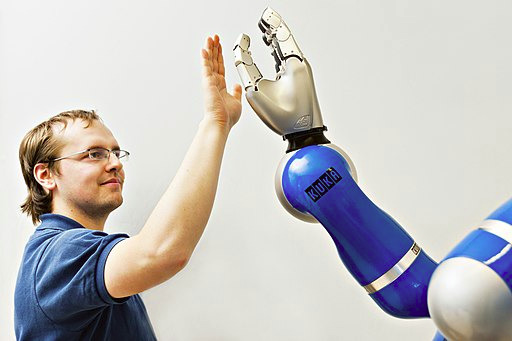
collaborative robotRobots, yes - but cobots? The term 'cobot' is a portmanteau of  "collaborative robot", a robot designed for human interaction. Traditional industrial robots would typically be isolated from humans for safety reasons. Cobots operate alongside people within the same space.

Collaborative robots are promoted as being cost-effective, safe, and flexible to deploy. Cobots designed to share a workspace with humans make automation easier in a variety of applications, according to Universal Robots.

Robots that will be able to exist next to people in our homes, factories, and offices and navigate safely around us is seen as possible in the next 5-10 years.

Similar to industrial robots, cobots can automate manual processes but can also do jobs that humans don't want to do. What kind of jobs does that include? Tasks that are repetitive, tedious, dirty, or dangerous. So, injury reduction is one of the benefits of working with cobots. Strenuous lifting and repetitive movement are common workplace injuries.

Not to insult the humans reading this, but robots and cobots offer far higher levels of consistency than humans. That is a key benefit in tasks that require a high degree of precision.

The cobots we are using emerge tend to be more compact and lightweight than conventional robots. They are also more user-friendly and require fewer or no engineers or programmers to set up ad monitor operations.

MORE at euronews.com/next/...